Ch. 6 - Applications of Integration
Briggs - Calculus: Early Transcendentals 3rd Edition
Briggs3rd EditionCalculus: Early TranscendentalsISBN: 9780136847243Not the one you use?Change textbook
Chapter 6, Problem 6.1.9d

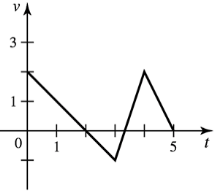
9–10. Velocity graphs The figures show velocity functions for motion along a line. Assume the motion begins with an initial position of s(0)=0. Determine the following.
img
d. A piecewise function for s(t)

Verified step by step guidance
1
Identify the intervals on the time axis where the velocity function v(t) changes its behavior. From the graph, these intervals are: 0 ≤ t ≤ 2, 2 ≤ t ≤ 4, and 4 ≤ t ≤ 6.
For each interval, determine the equation of the velocity function v(t). For example, from t=0 to t=2, the velocity decreases linearly from 2 to 0, so find the slope and write the linear equation for v(t) in that interval. Repeat this for the other intervals.
Recall that the position function s(t) is the integral of the velocity function v(t) with respect to time t, plus the initial position s(0). Since s(0) = 0, the position function on each interval is the integral of the corresponding velocity function starting from the beginning of that interval, plus the position at the start of the interval.
Calculate the position function s(t) piecewise by integrating each velocity function over its interval. For each interval, express s(t) as an integral of v(t) plus the position value at the start of that interval (which comes from the previous interval's calculation).
Combine these results to write the full piecewise function for s(t), ensuring continuity at the interval boundaries by using the position values found at the end of each previous interval as the starting values for the next.

Verified video answer for a similar problem:

This video solution was recommended by our tutors as helpful for the problem above.
Video duration:
12m
Was this helpful?

Key Concepts

Here are the essential concepts you must grasp in order to answer the question correctly.

Relationship Between Velocity and Position

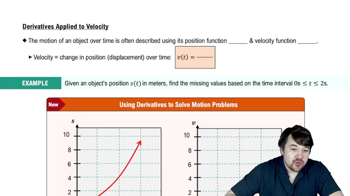
Velocity is the derivative of position with respect to time, meaning that the position function s(t) can be found by integrating the velocity function v(t). Given an initial position s(0), integrating v(t) over time gives the displacement, which when added to s(0) yields the position at any time t.
Recommended video:
06:29
Derivatives Applied To Velocity

Piecewise Functions

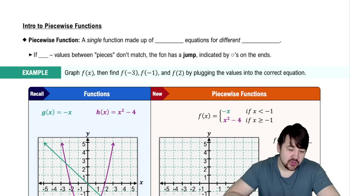
A piecewise function is defined by different expressions over different intervals of the domain. Since the velocity graph changes slope and sign at specific times, the position function s(t) must be expressed as a piecewise integral of v(t) over those intervals, ensuring continuity and correct initial conditions.
Recommended video:
05:36
Piecewise Functions

Definite Integration and Area Under the Curve

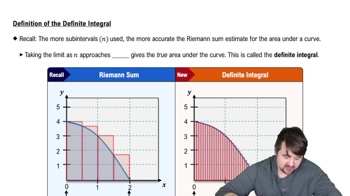
The position change over an interval is the definite integral of velocity over that interval, which corresponds to the net area under the velocity curve. Positive areas increase position, while negative areas decrease it, so calculating these areas accurately is essential for constructing s(t).
Recommended video:
05:43
Definition of the Definite Integral
Related Practice
Textbook Question

Use the region R that is bounded by the graphs of y=1+√x,x=4, and y=1 complete the exercises.


Region R is revolved about the y-axis to form a solid of revolution whose cross sections are washers.


d. Write an integral for the volume of the solid.

Textbook Question

Let R be the region in the first quadrant bounded above by the curve y=2−x² and bounded below by the line y=x. Suppose the shell method is used to determine the volume of the solid generated by revolving R about the y-axis.

c. Write an integral for the volume of the solid using the shell method.

Textbook Question

Use the region R that is bounded by the graphs of y=1+√x,x=4, and y=1 complete the exercises.


Region R is revolved about the x-axis to form a solid of revolution whose cross sections are washers.


d. Write an integral for the volume of the solid.

Textbook Question

Filling a tank A 2000-liter cistern is empty when water begins flowing into it (at t=0 at a rate (in L/min) given by Q′(t) = 3√t, where t is measured in minutes.


c. When will the tank be full?

Textbook Question

Piecewise velocity The velocity of a (fast) automobile on a straight highway is given by the function

v(t)={3t if 0t<2060 if 20t<452404t if t45v(t)= \(\begin{cases}\)3 t & \(\text\) { if } 0 \(\leq\) t<20 \\ 60 & \(\text\) { if } 20 \(\leq\) t<45 \\ 240-4 t & \(\text\) { if } t \(\geq\) 45\(\end{cases}\)

where is measured in seconds and v has units of m/s. 

d. What is the position of the automobile when t=75?

Textbook Question

Flow rates in the Spokane River The daily discharge of the Spokane River as it flows through Spokane, Washington, in April and June is modeled by the functions

r1(t) = 0.25t²+37.46t+722.47 (April) and

r2(t) = 0.90t²−69.06t+2053.12 (June), where the discharge is measured in millions of cubic feet per day, and t=0 corresponds to the beginning of the first day of the month (see figure).

c. The Spokane River flows out of Lake Coeur d’Alene, which contains approximately 0.67mi³ of water. Determine the percentage of Lake Coeur d’Alene’s volume that flows through Spokane in April and June.