
Textbook Question
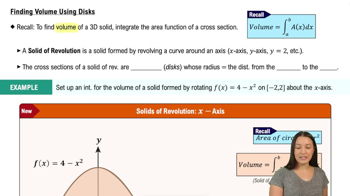
Let R be the region bounded by the following curves. Find the volume of the solid generated when R is revolved about the given axis.
y=4−x^2,x=2, and y=4; about the y-axis

 Verified step by step guidance
 04:48
04:48
 07:45
07:45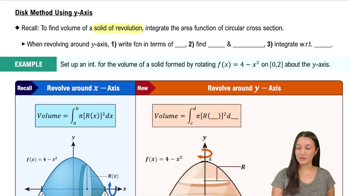 06:30
06:30Let R be the region bounded by the following curves. Find the volume of the solid generated when R is revolved about the given axis.
y=4−x^2,x=2, and y=4; about the y-axis
35–38. Shell and washer methods Let R be the region bounded by the following curves. Use both the shell method and the washer method to find the volume of the solid generated when R is revolved about the indicated axis.
y = (x−2)³ −2,x=0, and y=25; about the y-axis
29–36. Position and velocity from acceleration Find the position and velocity of an object moving along a straight line with the given acceleration, initial velocity, and initial position. Use the Fundamental Theorem of Calculus (Theorems 6.1 and 6.2).
a(t) = −32; v(0)=50; s(0)=0
Express the area of the shaded region in Exercise 5 as the sum of two integrals with respect to y. Do not evaluate the integrals.
9–20. Arc length calculations Find the arc length of the following curves on the given interval.
y = x^3/2 / 3 − x^1/2 on [4, 16]
35–38. Shell and washer methods Let R be the region bounded by the following curves. Use both the shell method and the washer method to find the volume of the solid generated when R is revolved about the indicated axis.
y = 8,y = 2x+2,x = 0, and x=2; about the y-axis