
Ch. 6 - Applications of Integration
Briggs - Calculus: Early Transcendentals 3rd Edition
Briggs3rd EditionCalculus: Early TranscendentalsISBN: 9780136847243Not the one you use?Change textbook
Chapter 6, Problem 6.4.8c

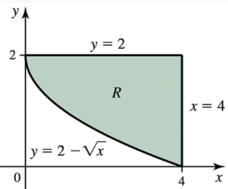
6–8. Let R be the region bounded by the curves y = 2−√x,y=2, and x=4 in the first quadrant.
Graph showing region R bounded by y=2, y=2−√x, and x=4 in the first quadrant, illustrating the shell method for volume.
Suppose the shell method is used to determine the volume of the solid generated by revolving R about the line x=4.
c. Write an integral for the volume of the solid using the shell method.

Verified step by step guidance
1
Step 1: Understand the shell method. The shell method involves integrating the volume of cylindrical shells formed by revolving a region around a vertical or horizontal axis. The formula for the volume is: \( V = \int_{a}^{b} 2\pi \cdot \text{radius} \cdot \text{height} \cdot dx \).
Step 2: Identify the radius and height of the shells. Since the region R is revolved around the line \( x = 4 \), the radius of a shell is \( 4 - x \) (distance from the line \( x = 4 \) to a point \( x \) in the region). The height of the shell is given by the difference between the upper curve \( y = 2 \) and the lower curve \( y = 2 - \sqrt{x} \).
Step 3: Set up the integral bounds. The region R is bounded horizontally between \( x = 0 \) and \( x = 4 \). These will be the limits of integration.
Step 4: Write the integral expression for the volume. Using the shell method formula, the integral becomes: \( V = \int_{0}^{4} 2\pi (4 - x) \cdot [(2) - (2 - \sqrt{x})] \cdot dx \).
Step 5: Simplify the height expression inside the integral. The height \( (2) - (2 - \sqrt{x}) \) simplifies to \( \sqrt{x} \). Thus, the integral for the volume becomes: \( V = \int_{0}^{4} 2\pi (4 - x) \cdot \sqrt{x} \cdot dx \).

Verified video answer for a similar problem:

This video solution was recommended by our tutors as helpful for the problem above.
Video duration:
1m
Was this helpful?

Key Concepts

Here are the essential concepts you must grasp in order to answer the question correctly.

Region Bounded by Curves

In this problem, the region R is defined by the curves y = 2, y = 2 - √x, and the vertical line x = 4. Understanding how to identify and sketch the area bounded by these curves is crucial for visualizing the solid of revolution. The intersection points of these curves help determine the limits of integration when calculating volume.
Recommended video:
07:45
Area of Polar Regions

Shell Method

The shell method is a technique for finding the volume of a solid of revolution. It involves slicing the solid into cylindrical shells and integrating the volume of these shells. When revolving around a vertical line, the formula for the volume V is given by V = 2π ∫ (radius)(height) dx, where the radius is the distance from the axis of rotation to the shell and height is the function value.
Recommended video:
07:33
Euler's Method

Setting Up the Integral

To write the integral for the volume using the shell method, one must determine the appropriate limits of integration and the expressions for the radius and height. In this case, the radius is (4 - x) and the height is (2 - (2 - √x)) = √x. The integral will be set up from x = 0 to x = 4, capturing the entire region R as it revolves around the line x = 4.
Recommended video:
07:06
Integration by Parts for Definite Integrals Example 8
Related Practice
Textbook Question

{Use of Tech} Oscillating motion A mass hanging from a spring is set in motion, and its ensuing velocity is given by v(t) = 2π cos πt, for t≥0. Assume the positive direction is upward and s(0)=0. 


c. At what times does the mass reach its low point the first three times? 

Textbook Question

Cycling distance A cyclist rides down a long straight road with a velocity (in m/min) given by v(t) = 400−20t, for 0≤t≤10, where t is measured in minutes.


c. How far has the cyclist traveled when her velocity is 250 m/min?

1
views
Textbook Question

Explain why or why not Determine whether the following statements are true and give an explanation or counterexample.

c. If a region is revolved about the x-axis, then in principle, it is possible to use the disk/washer method and integrate with respect to x or to use the shell method and integrate with respect to y.

Textbook Question

13–16. Displacement from velocity Consider an object moving along a line with the given velocity v. Assume time t is measured in seconds and velocities have units of m/s.


c. Find the distance traveled over the given interval.


v(t) = 3t²−6t on [0, 3]

Textbook Question

Distance traveled and displacement Suppose an object moves along a line with velocity (in ft/s) v(t)=6−2t, for 0≤t≤6, where t is measured in seconds.


c. Find the distance traveled by the object on the interval 0≤t≤6.

Textbook Question

Acceleration A drag racer accelerates at a(t)=88 ft/s². Assume v(0)=0, s(0)=0, and t is measured in seconds.


c. At this rate, how long will it take the racer to travel 1/4 mi?

1
views