Ch. 6 - Applications of Integration
Briggs - Calculus: Early Transcendentals 3rd Edition
Briggs3rd EditionCalculus: Early TranscendentalsISBN: 9780136847243Not the one you use?Change textbook
Chapter 6, Problem 6.4.61

53–62. Choose your method Let R be the region bounded by the following curves. Use the method of your choice to find the volume of the solid generated when R is revolved about the given axis.
y = x²,y=2−x, and x=0, in the first quadrant; about the y-axis

Verified step by step guidance
1
First, identify the region R bounded by the curves: \(y = x^{2}\), \(y = 2 - x\), and \(x = 0\) in the first quadrant. Sketching these curves helps visualize the area and the solid formed when revolving around the y-axis.
Determine the points of intersection between \(y = x^{2}\) and \(y = 2 - x\) by setting \(x^{2} = 2 - x\). Solve this equation to find the x-values where the curves meet, which will serve as limits of integration.
Since the solid is generated by revolving the region around the y-axis, decide on the method to use: the shell method is often convenient when revolving around the y-axis and the functions are given in terms of x.
Set up the volume integral using the shell method formula: \(V = \int_{a}^{b} 2\pi \cdot (\text{radius}) \cdot (\text{height}) \, dx\). Here, the radius is the distance from the y-axis, which is \(x\), and the height is the vertical distance between the curves, \( (2 - x) - x^{2} \).
Write the integral explicitly as \(V = \int_{x=a}^{x=b} 2\pi x \left( (2 - x) - x^{2} \right) dx\), where \(a\) and \(b\) are the intersection points found earlier. This integral represents the volume of the solid formed by revolving the region around the y-axis.

Verified video answer for a similar problem:

This video solution was recommended by our tutors as helpful for the problem above.
Video duration:
6m
Was this helpful?

Key Concepts

Here are the essential concepts you must grasp in order to answer the question correctly.

Setting up the region bounded by curves

Understanding the region R requires identifying the area enclosed by the curves y = x², y = 2 - x, and the line x = 0 in the first quadrant. This involves finding the points of intersection and sketching the region to visualize the limits of integration.
Recommended video:
05:23
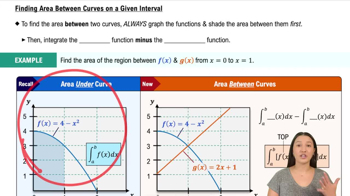
Finding Area Between Curves on a Given Interval

Methods of finding volumes of solids of revolution

Volumes generated by revolving a region around an axis can be found using methods like the disk/washer method or the shell method. Choosing the appropriate method depends on the axis of rotation and the shape of the region to simplify integration.
Recommended video:
04:48
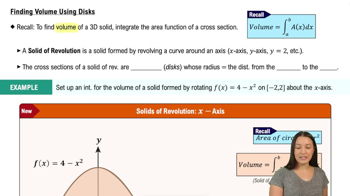
Finding Volume Using Disks

Volume calculation about the y-axis using the shell method

When revolving around the y-axis, the shell method is often convenient. It involves integrating cylindrical shells with radius equal to the x-value and height given by the difference of the functions, integrating with respect to x over the region's domain.
Recommended video:
06:30
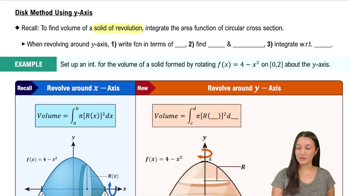
Disk Method Using y-Axis