Ch. 5 - Integration
Briggs - Calculus: Early Transcendentals 3rd Edition
Briggs3rd EditionCalculus: Early TranscendentalsISBN: 9780136847243Not the one you use?Change textbook
Chapter 5, Problem 5.5.16d

Use Table 5.6 to evaluate the following definite integrals.                                                                                                                    
 (d) ∫₀^π/¹⁶ sec ² 4𝓍 d𝓍

Verified step by step guidance
1
Step 1: Recognize the integral ∫₀^(π/16) sec²(4𝓍) d𝓍 as a standard form integral. The integral of sec²(u) with respect to u is tan(u).
Step 2: Identify the substitution needed for the integral. Let u = 4𝓍, which implies that du = 4 d𝓍. Rewrite the integral in terms of u.
Step 3: Adjust the limits of integration based on the substitution. When 𝓍 = 0, u = 4(0) = 0. When 𝓍 = π/16, u = 4(π/16) = π/4.
Step 4: Rewrite the integral using the substitution: ∫₀^(π/16) sec²(4𝓍) d𝓍 becomes (1/4) ∫₀^(π/4) sec²(u) du, where the factor 1/4 comes from the substitution du = 4 d𝓍.
Step 5: Evaluate the integral ∫₀^(π/4) sec²(u) du using the antiderivative of sec²(u), which is tan(u). Substitute the limits of integration into tan(u) and multiply by the factor 1/4 to complete the solution.

Verified video answer for a similar problem:

This video solution was recommended by our tutors as helpful for the problem above.
Video duration:
1m
Was this helpful?

Key Concepts

Here are the essential concepts you must grasp in order to answer the question correctly.

Definite Integrals

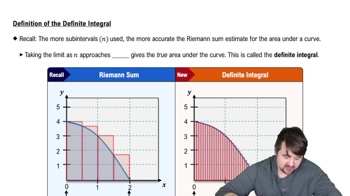
A definite integral represents the signed area under a curve between two specified limits. It is denoted as ∫_a^b f(x) dx, where 'a' and 'b' are the lower and upper limits, respectively. The result of a definite integral is a numerical value that quantifies the accumulation of the function's values over the interval [a, b]. Understanding how to evaluate definite integrals is crucial for solving problems in calculus.
Recommended video:
05:43
Definition of the Definite Integral

Integration Techniques

Integration techniques are methods used to find the integral of a function, especially when it cannot be integrated using basic formulas. Common techniques include substitution, integration by parts, and using trigonometric identities. In this context, recognizing the appropriate technique to apply is essential for evaluating the integral effectively, particularly when dealing with functions like sec²(4x).
Recommended video:
06:18
Integration by Parts for Definite Integrals

Trigonometric Functions

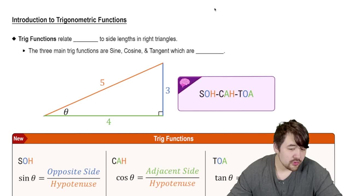
Trigonometric functions, such as secant (sec), are fundamental in calculus and relate angles to ratios of sides in right triangles. The secant function is defined as the reciprocal of the cosine function, sec(x) = 1/cos(x). Understanding the properties and derivatives of trigonometric functions is vital for evaluating integrals involving these functions, as they often appear in various calculus problems.
Recommended video:
6:04
Introduction to Trigonometric Functions