Ch. 5 - Integration
Briggs - Calculus: Early Transcendentals 3rd Edition
Briggs3rd EditionCalculus: Early TranscendentalsISBN: 9780136847243Not the one you use?Change textbook
Chapter 5, Problem 5.2.32d

{Use of Tech} Approximating definite integrals Complete the following steps for the given integral and the given value of n. 
(d) Determine which Riemann sum (left or right) underestimates the value of the definite integral and which overestimates the value of the definite integral..


βˆ«β‚€Β² (𝓍²―2) d𝓍 ; n = 4

Verified step by step guidance
1
Step 1: Understand the problem. The goal is to approximate the definite integral βˆ«β‚€Β² (𝓍² - 2) d𝓍 using Riemann sums with n = 4 subintervals. Additionally, determine which Riemann sum (left or right) underestimates or overestimates the integral.
Step 2: Divide the interval [0, 2] into n = 4 subintervals. The width of each subinterval, Δ𝓍, is calculated as Δ𝓍 = (b - a) / n, where a = 0 and b = 2. This gives Δ𝓍 = 2 / 4 = 0.5.
Step 3: For the left Riemann sum, use the left endpoints of each subinterval to evaluate the function f(𝓍) = 𝓍² - 2. The left endpoints are 𝓍₀ = 0, 𝓍₁ = 0.5, 𝓍₂ = 1, and 𝓍₃ = 1.5. Compute the sum as L = Δ𝓍 * [f(𝓍₀) + f(𝓍₁) + f(𝓍₂) + f(𝓍₃)].
Step 4: For the right Riemann sum, use the right endpoints of each subinterval to evaluate the function f(𝓍) = 𝓍² - 2. The right endpoints are 𝓍₁ = 0.5, 𝓍₂ = 1, 𝓍₃ = 1.5, and 𝓍₄ = 2. Compute the sum as R = Δ𝓍 * [f(𝓍₁) + f(𝓍₂) + f(𝓍₃) + f(𝓍₄)].
Step 5: Analyze the behavior of the function f(𝓍) = 𝓍² - 2 over the interval [0, 2]. Since the function is increasing on this interval, the left Riemann sum will underestimate the integral (as it uses lower values of the function), and the right Riemann sum will overestimate the integral (as it uses higher values of the function).

Verified video answer for a similar problem:

This video solution was recommended by our tutors as helpful for the problem above.
Video duration:
2m
Was this helpful?

Key Concepts

Here are the essential concepts you must grasp in order to answer the question correctly.

Riemann Sums

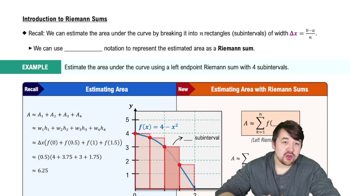
Riemann sums are a method for approximating the value of a definite integral by dividing the area under a curve into smaller rectangles. The sum of the areas of these rectangles provides an estimate of the integral's value. Depending on whether the left or right endpoints of the subintervals are used, the Riemann sum can either overestimate or underestimate the actual area, which is crucial for understanding the behavior of the integral.
Recommended video:
06:11
Introduction to Riemann Sums

Definite Integrals

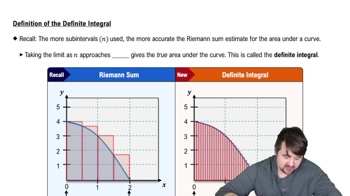
A definite integral represents the signed area under a curve between two specified limits. It is denoted as βˆ«β‚α΅‡ f(x) dx, where 'a' and 'b' are the lower and upper limits, respectively. The value of a definite integral can be interpreted as the accumulation of quantities, such as area, over an interval, making it essential for applications in physics, engineering, and economics.
Recommended video:
05:43
Definition of the Definite Integral

Underestimation and Overestimation

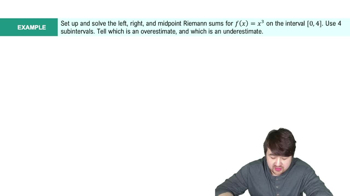
In the context of Riemann sums, underestimation occurs when the sum of the areas of the rectangles is less than the actual area under the curve, while overestimation occurs when the sum exceeds the actual area. For a function that is increasing on the interval, the left Riemann sum will underestimate the integral, and the right Riemann sum will overestimate it. Conversely, for a decreasing function, the opposite is true, highlighting the importance of the function's behavior in determining the accuracy of the approximation.
Recommended video:
10:22
Left, Right, & Midpoint Riemann Sums Example 1