
Ch. 5 - Integration
Briggs - Calculus: Early Transcendentals 3rd Edition
Briggs3rd EditionCalculus: Early TranscendentalsISBN: 9780136847243Not the one you use?Change textbook
Chapter 5, Problem 5.R.25

Use geometry and properties of integrals to evaluate the following definite integrals.                                                                                          
                                                                                                                                                                       
 ∫₀⁴ √(8𝓍―𝓍²) d𝓍 . (Hint: Complete the square .)

Verified step by step guidance
1
Step 1: Recognize that the integral ∫₀⁴ √(8𝓍 - 𝓍²) d𝓍 represents the area under the curve of the function √(8𝓍 - 𝓍²) from x = 0 to x = 4. To simplify the integrand, complete the square for the expression inside the square root: 8𝓍 - 𝓍².
Step 2: Rewrite 8𝓍 - 𝓍² as - (𝓍² - 8𝓍). Factor out the negative sign and complete the square for the quadratic expression inside the parentheses: 𝓍² - 8𝓍 = (𝓍 - 4)² - 16. Thus, 8𝓍 - 𝓍² becomes -((𝓍 - 4)² - 16) = 16 - (𝓍 - 4)².
Step 3: Substitute the completed square form into the integral. The integral becomes ∫₀⁴ √(16 - (𝓍 - 4)²) d𝓍. Notice that this represents the equation of a semicircle with radius 4 centered at x = 4.
Step 4: Use the geometric interpretation of the integral. The function √(16 - (𝓍 - 4)²) describes the upper half of a circle with radius 4. The area under this curve from x = 0 to x = 4 corresponds to a quarter-circle of radius 4.
Step 5: Calculate the area of the quarter-circle using the formula for the area of a circle, A = πr². Since this is a quarter-circle, the area is (1/4)πr², where r = 4. Substitute r = 4 into the formula to find the area.

Verified video answer for a similar problem:

This video solution was recommended by our tutors as helpful for the problem above.
Video duration:
4m
Was this helpful?

Key Concepts

Here are the essential concepts you must grasp in order to answer the question correctly.

Definite Integrals

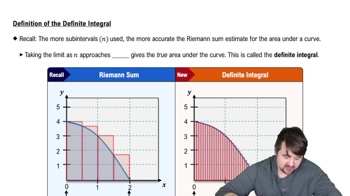
A definite integral represents the signed area under a curve between two specified limits. It is denoted as ∫[a,b] f(x) dx, where 'a' and 'b' are the lower and upper limits, respectively. The value of a definite integral can be interpreted geometrically as the net area between the function f(x) and the x-axis over the interval [a, b]. Understanding how to evaluate definite integrals is crucial for solving problems involving area and accumulation.
Recommended video:
05:43
Definition of the Definite Integral

Completing the Square

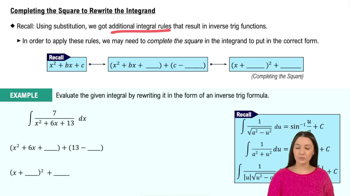
Completing the square is a technique used to transform a quadratic expression into a perfect square trinomial. This method is particularly useful in integration, as it simplifies the integrand into a form that is easier to integrate. For example, the expression ax² + bx + c can be rewritten as a(x - h)² + k, where (h, k) is the vertex of the parabola. This technique is essential for evaluating integrals involving square roots of quadratic expressions.
Recommended video:
05:22
Completing the Square to Rewrite the Integrand

Geometric Interpretation of Integrals

The geometric interpretation of integrals involves visualizing the area under a curve as a sum of infinitesimally small rectangles. This concept is foundational in calculus, as it connects the algebraic process of integration with geometric ideas. By understanding how to represent functions graphically, students can better grasp the significance of definite integrals in calculating areas, volumes, and other physical quantities, making it easier to approach problems involving integrals.
Recommended video:
Guided course
04:18
Geometric Sequences - Recursive Formula
Related Practice
Textbook Question

Area functions and the Fundamental Theorem Consider the function

ƒ(t) = { t      if  ―2 ≤ t < 0

t²/2    if    0 ≤ t ≤ 2

and its graph shown below. Let F(𝓍) = ∫₋₁ˣ ƒ(t) dt and G(𝓍) = ∫₋₂ˣ ƒ(t) dt.

(d) Evaluate F ' (―1) and F ' (1). Interpret these values.

1
views
Textbook Question

Evaluating integrals Evaluate the following integrals.


∫π/₁₂^π/⁹ (csc 3𝓍 cot 3𝓍 + sec 3𝓍 tan 3𝓍) d𝓍

Textbook Question

Displacement from velocity A particle moves along a line with a velocity given by v(t) = 5 sin πt, starting with an initial position s(0) = 0 . Find the displacement of the particle between t = 0 and t = 2 , which is given by s(t) = ∫₀² v(t) dt . Find the distance traveled by the particle during this interval, which is ∫₀² |v(t)| dt .

3
views
Textbook Question

Function defined by an integral Let H (𝓍) = ∫₀ˣ √(4 ― t²) dt, for ― 2 ≤ 𝓍 ≤ 2.

(c) Evaluate H '(2) .

Textbook Question

Evaluating integrals Evaluate the following integrals.                                                                                                                                         


 ∫ y² (3y³ + 1)⁴ dy

Textbook Question

Estimate ∫₁⁴ √(4𝓍 + 1) d𝓍 by evaluating the left, right, and midpoint Riemann sums using a regular partition with n = 6 subintervals.