Ch. 5 - Integration
Briggs - Calculus: Early Transcendentals 3rd Edition
Briggs3rd EditionCalculus: Early TranscendentalsISBN: 9780136847243Not the one you use?Change textbook
Chapter 5, Problem 5.RE.15e

Symmetry properties Suppose ∫₀⁎ ƒ(𝓍) d𝓍 = 10 and ∫₀⁎ g(𝓍) d𝓍 = 20. Furthermore, suppose ƒ is an even function and g is an odd function. Evaluate the following integrals.


(e) ∫₋₂ÂČ 3đ“Æ’(𝓍)d𝓍

Verified step by step guidance
1
Step 1: Understand the symmetry properties of the functions. An even function satisfies ƒ(𝓍) = ƒ(-𝓍), meaning it is symmetric about the y-axis. An odd function satisfies g(𝓍) = -g(-𝓍), meaning it is symmetric about the origin.
Step 2: Analyze the integral ∫₋₂ÂČ 3đ“Æ’(𝓍)d𝓍. Notice that the integrand 3đ“Æ’(𝓍) is a product of 𝓍 (an odd function) and ƒ(𝓍) (an even function). The product of an odd function and an even function is an odd function.
Step 3: Recall a key property of definite integrals for odd functions: ∫₋đ“Ș^đ“Ș h(𝓍)d𝓍 = 0 if h(𝓍) is an odd function. This property applies because the contributions from the interval [-đ“Ș, 0] and [0, đ“Ș] cancel each other out.
Step 4: Conclude that the integrand 3đ“Æ’(𝓍) is odd, and the integral ∫₋₂ÂČ 3đ“Æ’(𝓍)d𝓍 evaluates to 0 based on the symmetry property of odd functions.
Step 5: Summarize the reasoning: The integral evaluates to 0 because the integrand is an odd function and the limits of integration are symmetric about the origin.

Verified video answer for a similar problem:

This video solution was recommended by our tutors as helpful for the problem above.
Video duration:
2m
Was this helpful?

Key Concepts

Here are the essential concepts you must grasp in order to answer the question correctly.

Even and Odd Functions

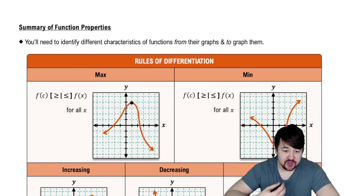
An even function is defined by the property f(-x) = f(x) for all x in its domain, which means its graph is symmetric about the y-axis. Conversely, an odd function satisfies g(-x) = -g(x), indicating that its graph is symmetric about the origin. Understanding these properties is crucial for evaluating integrals, as they can simplify calculations by exploiting symmetry.
Recommended video:
06:21
Properties of Functions

Properties of Definite Integrals

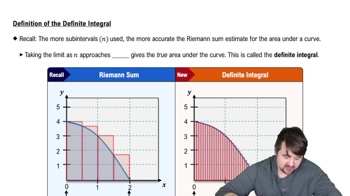
Definite integrals have specific properties that can simplify their evaluation. For instance, the integral of an even function over a symmetric interval [-a, a] can be expressed as twice the integral from 0 to a. In contrast, the integral of an odd function over a symmetric interval is zero. These properties are essential for solving integrals involving even and odd functions.
Recommended video:
05:43
Definition of the Definite Integral

Integration Techniques

Integration techniques involve various methods for calculating integrals, including substitution, integration by parts, and recognizing patterns in functions. In this context, recognizing the symmetry of the functions involved allows for the application of specific techniques that can simplify the evaluation of the integral, particularly when combined with the properties of even and odd functions.
Recommended video:
06:18
Integration by Parts for Definite Integrals
Related Practice
Textbook Question

Area by geometry Use geometry to evaluate the following definite integrals, where the graph of ƒ is given in the figure.

(a) ∫₀⁎ ƒ(𝓍) d𝓍

1
views
Textbook Question

Approximating areas Estimate the area of the region bounded by the graph of ƒ(𝓍) = xÂČ + 2 and the x-axis on [0, 2] in the following ways.

(a) Divide [0, 2] into n = 4 subintervals and approximate the area of the region using a left Riemann sum. Illustrate the solution geometrically.

Textbook Question

The velocity in ft/s of an object moving along a line is given by v = ƒ(t) on the interval 0 ≀ t ≀ 6 (see figure), where t is measured in seconds.


(a) Divide the interval [0,6] into n = 3 subintervals, [0,2] , [2,4] and [4,6]. On each subinterval, assume the object moves at a constant velocity equal to the value of v evaluated at the right endpoint of the subinterval, and use these approximations to estimate the displacement of the object on [0,6] (see part (a) of the figure)                                                                                                             


1
views
Textbook Question

Sigma notation Evaluate the following expressions.

(a)    10                                                                                                                                                                               

       âˆ‘ Îș                                                                                                                                                                          

       Îș=1                         

Textbook Question

Symmetry properties Suppose ∫₀⁎ ƒ(𝓍) d𝓍 = 10 and ∫₀⁎ g(𝓍) d𝓍 = 20. Furthermore, suppose ƒ is an even function and g is an odd function. Evaluate the following integrals.


(a) ∫₋₄⁎ ƒ(𝓍) d𝓍

Textbook Question

Symmetry properties Suppose ∫₀⁎ ƒ(𝓍) d𝓍 = 10 and ∫₀⁎ g(𝓍) d𝓍 = 20. Furthermore, suppose ƒ is an even function and g is an odd function. Evaluate the following integrals.


(c) ∫₋₄⁎ (4ƒ(𝓍) ― 3g(𝓍))d𝓍