Ch. 5 - Integration
Briggs - Calculus: Early Transcendentals 3rd Edition
Briggs3rd EditionCalculus: Early TranscendentalsISBN: 9780136847243Not the one you use?Change textbook
Chapter 5, Problem 5.5.100b

Substitutions Suppose ƒ is an even function with ∫₀⁸ ƒ(𝓍) d𝓍 = 9 . Evaluate each integral.                                                                                                       
(b) ∫²₋₂ 𝓍²ƒ(𝓍³) d𝓍

Verified step by step guidance
1
Step 1: Recognize that the integral involves a substitution. The given integral is ∫²₋₂ 𝓍²ƒ(𝓍³) d𝓍. To simplify, let u = 𝓍³. Then, compute the derivative of u with respect to 𝓍: du/d𝓍 = 3𝓍², or equivalently, du = 3𝓍² d𝓍.
Step 2: Rewrite the integral in terms of u. Substitute u = 𝓍³ and du = 3𝓍² d𝓍 into the integral. The integral becomes (1/3) ∫ f(u) du, where the factor of 1/3 comes from the substitution.
Step 3: Adjust the limits of integration. When 𝓍 = -2, u = (-2)³ = -8. When 𝓍 = 2, u = (2)³ = 8. Therefore, the new limits of integration are from u = -8 to u = 8.
Step 4: Use the property of even functions. Since ƒ is an even function, ƒ(u) = ƒ(-u). This allows us to simplify the integral over symmetric limits. Specifically, ∫₋₈⁸ ƒ(u) du = 2 ∫₀⁸ ƒ(u) du.
Step 5: Substitute the given value of ∫₀⁸ ƒ(𝓍) d𝓍 = 9 into the equation. The integral becomes (1/3) * 2 * 9. Simplify this expression to find the final result.

Verified video answer for a similar problem:

This video solution was recommended by our tutors as helpful for the problem above.
Video duration:
4m
Was this helpful?

Key Concepts

Here are the essential concepts you must grasp in order to answer the question correctly.

Even Functions

An even function is defined by the property that ƒ(−x) = ƒ(x) for all x in its domain. This symmetry about the y-axis implies that the area under the curve from -a to a is twice the area from 0 to a. Understanding this property is crucial for evaluating integrals involving even functions, as it simplifies calculations and allows for the use of symmetry.
Recommended video:
6:13
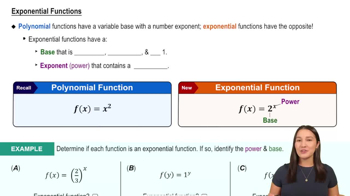
Exponential Functions

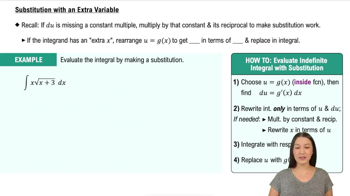
Substitution in Integration

Substitution is a technique used in integration to simplify the process by changing the variable of integration. It involves selecting a new variable, often denoted as u, which is a function of x, and transforming the integral accordingly. This method is particularly useful when dealing with composite functions, as it can make the integral more manageable and easier to solve.
Recommended video:
04:27
Substitution With an Extra Variable

Definite Integrals

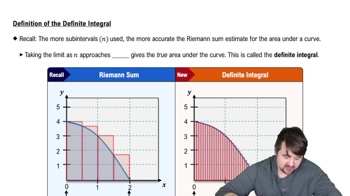
A definite integral represents the signed area under a curve between two specified limits, a and b. It is denoted as ∫ₐᵇ ƒ(x) dx and provides a numerical value that reflects the accumulation of quantities, such as area or volume. Understanding the properties of definite integrals, including their evaluation and the Fundamental Theorem of Calculus, is essential for solving problems involving area calculations and function analysis.
Recommended video:
05:43
Definition of the Definite Integral
Related Practice
Textbook Question

{Use of Tech} Midpoint Riemann sums with a calculator Consider the following definite integrals.

(b) Evaluate each sum using a calculator with n = 20, 50, and 100. Use these values to estimate the value of the integral.


∫₁⁴ 2√𝓍 d𝓍

Textbook Question

Explain why or why not Determine whether the following statements are true and give an explanation or counterexample. Assume ƒ, ƒ', and ƒ'' are continuous functions for all real numbers.                                                                                                                                                           


(b) ∫ (ƒ(𝓍))ⁿ ƒ'(𝓍) d𝓍 = 1/(n + 1) (ƒ(𝓍))ⁿ⁺¹ + C , n ≠ ―1 .

Textbook Question

Using properties of integrals Use the value of the first integral I to evaluate the two given integrals. 

I = ∫₀^π/2 (cos θ ― 2 sin θ) dθ = ―1

(b) ∫₀^π/2 (4 cos θ ― 8 sin θ) dθ

Textbook Question

Working with area functions Consider the function ƒ and its graph.

(b) Estimate the points (if any) at which A has a local maximum or minimum.


1
views
Textbook Question

Area functions for constant functions Consider the following functions ƒ and real numbers a (see figure).

(b) Verify that .A'(𝓍) = ƒ(𝓍)


ƒ(t) = 5 , a = -5

Textbook Question

Generalizing the Mean Value Theorem for Integrals Suppose ƒ and g are continuous on [a, b] and let h(𝓍) = (𝓍―b) ∫ₐˣ ƒ(t) dt + (𝓍―a) ∫ₓᵇg(t)dt.                                                                                                                                                                                                                                                                                                                                

(b) Show that there is a number c in (a, b) such that ∫ₐᶜ ƒ(t) dt = ƒ(c) (b ― c)                                                                                                              


(Source: The College Mathematics Journal, 33, 5, Nov 2002)