Ch. 5 - Integration
Briggs - Calculus: Early Transcendentals 3rd Edition
Briggs3rd EditionCalculus: Early TranscendentalsISBN: 9780136847243Not the one you use?Change textbook
Chapter 5, Problem 5.1.59b

Explain why or why not Determine whether the following statements are true and give an explanation or counterexample.
(b) A left Riemann sum always overestimates the area of a region bounded by a positive increasing function and the x-axis on an interval [a,b].

Verified step by step guidance
1
Understand the problem: A left Riemann sum is a method for approximating the area under a curve by summing up the areas of rectangles. The height of each rectangle is determined by the value of the function at the left endpoint of each subinterval. The question asks whether this method always overestimates the area for a positive increasing function on [a, b].
Recall the behavior of a positive increasing function: For such a function, the function value increases as x increases. This means that the function value at the left endpoint of any subinterval is less than or equal to the function value at the right endpoint of the same subinterval.
Visualize the left Riemann sum: When using the left endpoint to determine the height of each rectangle, the rectangles will be shorter than the actual curve over the subinterval because the function is increasing. This implies that the left Riemann sum will underestimate the true area under the curve.
Provide a counterexample: Consider the function f(x) = x on the interval [1, 2]. Divide the interval into two subintervals: [1, 1.5] and [1.5, 2]. The left Riemann sum uses the function values at x = 1 and x = 1.5 to calculate the heights of the rectangles. Clearly, these heights are less than the actual function values at the right endpoints (x = 1.5 and x = 2), leading to an underestimation of the area.
Conclude: The statement is false. A left Riemann sum does not always overestimate the area for a positive increasing function. In fact, it typically underestimates the area because the function value at the left endpoint is less than the function value at the right endpoint for an increasing function.

Verified video answer for a similar problem:

This video solution was recommended by our tutors as helpful for the problem above.
Video duration:
2m
Was this helpful?

Key Concepts

Here are the essential concepts you must grasp in order to answer the question correctly.

Riemann Sums

Riemann sums are a method for approximating the area under a curve by dividing the region into smaller subintervals and summing the areas of rectangles formed. The height of each rectangle can be determined using the function's value at specific points within each subinterval, such as the left endpoint, right endpoint, or midpoint. This technique is foundational in integral calculus, as it leads to the formal definition of the definite integral.
Recommended video:
06:11
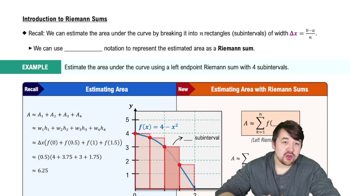
Introduction to Riemann Sums

Increasing Functions

An increasing function is one where, for any two points x1 and x2 in its domain, if x1 < x2, then f(x1) ≤ f(x2). In the context of Riemann sums, if the function is positive and increasing, the value of the function at the left endpoint of each subinterval will be less than or equal to the value at the right endpoint. This characteristic is crucial for understanding how Riemann sums behave in relation to the actual area under the curve.
Recommended video:
07:32
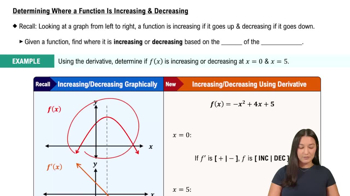
Determining Where a Function is Increasing & Decreasing

Overestimation and Underestimation

In the context of Riemann sums, overestimation occurs when the sum of the areas of the rectangles exceeds the actual area under the curve, while underestimation occurs when it falls short. For a positive increasing function, a left Riemann sum will use the left endpoint values, which are lower than the right endpoint values, leading to an underestimation of the area. Understanding this distinction is essential for evaluating the truth of the statement regarding left Riemann sums.
Recommended video:
10:22
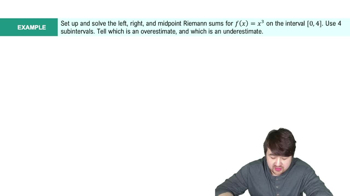
Left, Right, & Midpoint Riemann Sums Example 1