Ch. 5 - Integration
Briggs - Calculus: Early Transcendentals 3rd Edition
Briggs3rd EditionCalculus: Early TranscendentalsISBN: 9780136847243Not the one you use?Change textbook
Chapter 5, Problem 5.R.57

Evaluating integrals Evaluate the following integrals.


∫₀² (2𝓍 + 1)³ d𝓍

Verified step by step guidance
1
Step 1: Recognize that the integral ∫₀² (2𝓍 + 1)³ d𝓍 involves a polynomial raised to a power. To simplify, consider using substitution. Let u = 2𝓍 + 1, which transforms the integral into a simpler form.
Step 2: Compute the derivative of u with respect to 𝓍: du/d𝓍 = 2. Rearrange to express du in terms of d𝓍: du = 2 d𝓍.
Step 3: Adjust the limits of integration to match the substitution. When 𝓍 = 0, u = 2(0) + 1 = 1. When 𝓍 = 2, u = 2(2) + 1 = 5. The integral now becomes ∫₁⁵ u³ (1/2) du, where the factor 1/2 comes from the substitution for d𝓍.
Step 4: Factor out the constant 1/2 from the integral: (1/2) ∫₁⁵ u³ du. Now, apply the power rule for integration: ∫ uⁿ du = (uⁿ⁺¹)/(n+1) + C, where n is the exponent.
Step 5: Use the power rule to integrate u³: (1/2) [(u⁴)/4] evaluated from u = 1 to u = 5. Substitute the limits into the result to complete the evaluation.

Verified video answer for a similar problem:

This video solution was recommended by our tutors as helpful for the problem above.
Video duration:
2m
Was this helpful?

Key Concepts

Here are the essential concepts you must grasp in order to answer the question correctly.

Definite Integrals

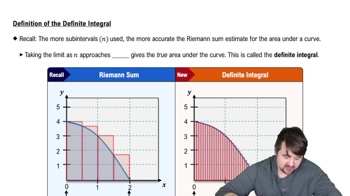
A definite integral represents the signed area under a curve defined by a function over a specific interval. In this case, the integral ∫₀² (2𝓍 + 1)³ d𝓍 calculates the area between the curve (2𝓍 + 1)³ and the x-axis from x = 0 to x = 2. The limits of integration (0 and 2) indicate the bounds of the area being evaluated.
Recommended video:
05:43
Definition of the Definite Integral

Integration Techniques

To evaluate integrals, various techniques can be employed, such as substitution, integration by parts, or polynomial expansion. For the integral ∫₀² (2𝓍 + 1)³ d𝓍, expanding the integrand (2𝓍 + 1)³ into a polynomial form can simplify the integration process, making it easier to compute the definite integral.
Recommended video:
06:18
Integration by Parts for Definite Integrals

Fundamental Theorem of Calculus

The Fundamental Theorem of Calculus links differentiation and integration, stating that if F is an antiderivative of f on an interval [a, b], then ∫ₐᵇ f(x) dx = F(b) - F(a). This theorem allows us to evaluate definite integrals by finding an antiderivative of the integrand, which is essential for solving the given integral problem.
Recommended video:
06:11
Fundamental Theorem of Calculus Part 1
Related Practice
Textbook Question

Explain why or why not Determine whether the following statements are true and give an explanation or counterexample. Assume ƒ and ƒ' are continuous functions for all real numbers.

(g) ∫ ƒ' (g(𝓍))g' (𝓍) d(𝓍) = ƒ(g(𝓍)) + C .

Textbook Question

Evaluating integrals Evaluate the following integrals.                                                                                                                                         


 ∫ sin 𝒵 sin (cos 𝒵) d𝒵

Textbook Question

Evaluating integrals Evaluate the following integrals.                                                                                                                                         


 ∫ y² /(y³ + 27) dy

Textbook Question

Explain why or why not Determine whether the following statements are true and give an explanation or counterexample. Assume ƒ and ƒ' are continuous functions for all real numbers.

(f) ∫ₐᵇ (2 ƒ(𝓍) ―3g (𝓍)) d𝓍 = 2 ∫ₐᵇ ƒ(𝓍) d𝓍 + 3 ∫₆ᵃ g(𝓍) d𝓍 .

Textbook Question

Explain why or why not Determine whether the following statements are true and give an explanation or counterexample. Assume ƒ and ƒ' are continuous functions for all real numbers.

(b) Given an area function A(𝓍) = ∫ₐˣ ƒ(t) dt and an antiderivative F of ƒ, it follows that A'(𝓍) = F(𝓍) .

1
views
Textbook Question

Evaluating integrals Evaluate the following integrals.                                                                                                                                         


 ∫ (cos 7ω) /(16 + sin² 7ω) dω