Ch. 5 - Integration
Briggs - Calculus: Early Transcendentals 3rd Edition
Briggs3rd EditionCalculus: Early TranscendentalsISBN: 9780136847243Not the one you use?Change textbook
Chapter 5, Problem 5.R.71

Evaluating integrals Evaluate the following integrals.


∫₋₅⁵ ω³ /√(ω⁵⁰ + ω²⁰ + 1) dω (Hint: Use symmetry . )

Verified step by step guidance
1
Recognize that the integral has symmetric limits of integration (-5 to 5) and analyze the integrand for symmetry. Specifically, check if the function is odd or even. A function f(ω) is odd if f(-ω) = -f(ω), and even if f(-ω) = f(ω).
Substitute -ω into the integrand to test for symmetry. The numerator ω³ changes sign to (-ω)³ = -ω³, while the denominator √(ω⁵⁰ + ω²⁰ + 1) remains unchanged because all powers of ω in the denominator are even.
Conclude that the integrand is an odd function because the numerator changes sign while the denominator does not. For an odd function integrated over symmetric limits (-a to a), the integral evaluates to 0.
Use the property of definite integrals for odd functions over symmetric intervals: ∫₋ₐᵃ f(ω) dω = 0. Apply this property to the given integral.
State that the integral evaluates to 0 due to the symmetry of the integrand and the odd function property over symmetric limits.

Verified video answer for a similar problem:

This video solution was recommended by our tutors as helpful for the problem above.
Video duration:
2m
Was this helpful?

Key Concepts

Here are the essential concepts you must grasp in order to answer the question correctly.

Definite Integrals

A definite integral represents the signed area under a curve between two specified limits. It is denoted as ∫[a, b] f(x) dx, where 'a' and 'b' are the lower and upper limits, respectively. Evaluating definite integrals often involves finding the antiderivative of the function and applying the Fundamental Theorem of Calculus.
Recommended video:
05:43
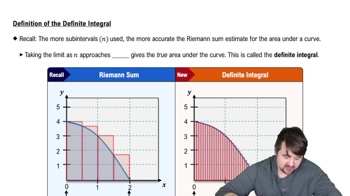
Definition of the Definite Integral

Symmetry in Integrals

Symmetry in integrals refers to the property that certain functions exhibit even or odd characteristics. An even function satisfies f(-x) = f(x), while an odd function satisfies f(-x) = -f(x). When integrating over symmetric limits, such as from -a to a, the integral of an odd function is zero, which can simplify calculations significantly.
Recommended video:
06:18
Integration by Parts for Definite Integrals

Substitution Method

The substitution method is a technique used to simplify the process of evaluating integrals. It involves changing the variable of integration to make the integral easier to solve. This is particularly useful when the integrand contains composite functions or complicated expressions, allowing for a more straightforward integration process.
Recommended video:
07:33
Euler's Method
Related Practice
Textbook Question

Change of variables Use the change of variables u³ = 𝓍² ― 1 to evaluate the integral ∫₁³ 𝓍∛(𝓍²―1) d𝓍 .

1
views

Textbook Question

Evaluating integrals Evaluate the following integrals.                                                                                                                                         


 ∫(√1 + tan 2t) sec² 2t dt

1
views
Textbook Question

Evaluating integrals Evaluate the following integrals.                                                                                                                                      


 ∫ 𝓍² cos 𝓍³ d𝓍

1
views
Textbook Question

Function defined by an integral Let H (𝓍) = ∫₀ˣ √(4 ― t²) dt, for ― 2 ≤ 𝓍 ≤ 2.

(e) Find the value of s such that H (𝓍) = sH(―𝓍)

Textbook Question

Integration by Riemann sums Consider the integral ∫₁⁴ (3𝓍― 2) d𝓍.


(a) Evaluate the right Riemann sum for the integral with n = 3 .

1
views
Textbook Question

Evaluating integrals Evaluate the following integrals.                                                                                                                                         


 ∫ 𝓍⁷ √(𝓍⁴ + 1d𝓍)