Ch. 5 - Integration
Briggs - Calculus: Early Transcendentals 3rd Edition
Briggs3rd EditionCalculus: Early TranscendentalsISBN: 9780136847243Not the one you use?Change textbook
Chapter 5, Problem 5.1.13

Does a right Riemann sum underestimate or overestimate the area of the region under the graph of a function that is positive and decreasing on an interval [a,b]? Explain.

Verified step by step guidance
1
Step 1: Understand the concept of a right Riemann sum. A right Riemann sum approximates the area under a curve by summing up the areas of rectangles whose heights are determined by the function value at the right endpoint of each subinterval.
Step 2: Consider the behavior of the function. The problem states that the function is positive and decreasing on the interval [a, b]. This means that as x increases, the function value f(x) decreases.
Step 3: Visualize the rectangles in the right Riemann sum. Since the function is decreasing, the height of each rectangle (determined by the function value at the right endpoint) will be less than the actual function value at most points within the subinterval.
Step 4: Compare the area of the rectangles to the actual area under the curve. Because the rectangles are shorter than the curve over each subinterval, the right Riemann sum will underestimate the total area under the graph of the function.
Step 5: Conclude the reasoning. For a positive and decreasing function on [a, b], the right Riemann sum underestimates the area under the curve because the function value at the right endpoint is smaller than the function values elsewhere in the subinterval.

Verified video answer for a similar problem:

This video solution was recommended by our tutors as helpful for the problem above.
Video duration:
1m
Was this helpful?

Key Concepts

Here are the essential concepts you must grasp in order to answer the question correctly.

Riemann Sums

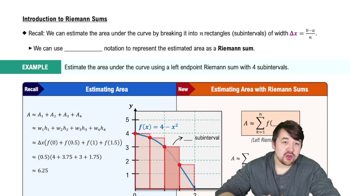
Riemann sums are a method for approximating the area under a curve by dividing the region into smaller subintervals and summing the areas of rectangles. The height of each rectangle is determined by the function's value at specific points within each subinterval, such as the left endpoint, right endpoint, or midpoint. This technique is foundational in integral calculus, as it leads to the formal definition of the definite integral.
Recommended video:
06:11
Introduction to Riemann Sums

Monotonic Functions

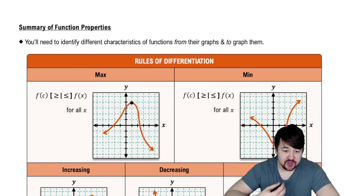
A monotonic function is one that is either entirely non-increasing or non-decreasing over a given interval. In this case, a positive and decreasing function means that as the input values increase, the output values decrease. Understanding the behavior of monotonic functions is crucial for analyzing how Riemann sums behave, particularly in determining whether they overestimate or underestimate the area under the curve.
Recommended video:
06:21
Properties of Functions

Underestimation and Overestimation

In the context of Riemann sums, underestimation occurs when the sum of the areas of the rectangles is less than the actual area under the curve, while overestimation occurs when the sum exceeds the actual area. For a positive and decreasing function, a right Riemann sum will use the function's value at the right endpoint of each subinterval, which is lower than the function's value at the left endpoint, leading to an underestimation of the area.
Recommended video:
10:22
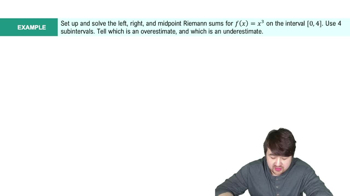
Left, Right, & Midpoint Riemann Sums Example 1
Related Practice
Textbook Question

Use the given substitution to evaluate the following indefinite integrals. Check your answer by differentiating.                                                                                              


 ∫ (6𝓍 + 1) √(3𝓍² + 𝓍) d𝓍 , u = 3𝓍² + 𝓍

Textbook Question

Definite integrals Use a change of variables or Table 5.6 to evaluate the following definite integrals.                                                                                                                         


 ∫₁³ ( 2ˣ / 2ˣ + 4 ) d𝓍

1
views
Textbook Question

A midpoint Riemann sum Approximate the area of the region bounded by the graph of ƒ(𝓍) = 100 ― x² and the x-axis on [0, 10] with n = 5 subintervals. Use the midpoint of each subinterval to determine the height of each rectangle (see figure).

Textbook Question

Symmetry in integrals Use symmetry to evaluate the following integrals.

∫₋π/₄^π/⁴ sec² x dx

Textbook Question

Indefinite integrals Use a change of variables or Table 5.6 to evaluate the following indefinite integrals. Check your work by differentiating.                                                                                  


 ∫ d𝓍 / (√1 ― 9𝓍²)

Textbook Question

{Use of Tech} Areas of regions Find the area of the region 𝑅 bounded by the graph of ƒ and the 𝓍-axis on the given interval. Graph ƒ and show the region 𝑅.                                              


 ƒ(𝓍) = 𝓍² (𝓍 ― 2) on [ ―1 , 3]