Ch. 5 - Integration
Briggs - Calculus: Early Transcendentals 3rd Edition
Briggs3rd EditionCalculus: Early TranscendentalsISBN: 9780136847243Not the one you use?Change textbook
Chapter 5, Problem 5.3.81

Derivatives of integrals Simplify the following expressions.


d/dz ∫¹⁰ₛᵢₙ ₂ dt /(t⁴ + 1)

Verified step by step guidance
1
Step 1: Recognize that the problem involves the derivative of an integral. This is a classic application of the Fundamental Theorem of Calculus, which states that if F(x) = ∫[a(x), b(x)] f(t) dt, then dF/dx = f(b(x)) * b'(x) - f(a(x)) * a'(x).
Step 2: Identify the bounds of the integral. The upper bound is 10, which is constant, and the lower bound is sin(z), which is a function of z. This means the derivative will involve the lower bound's derivative.
Step 3: Apply the Fundamental Theorem of Calculus. Since the upper bound is constant, its derivative contributes nothing. For the lower bound, substitute t = sin(z) into the integrand f(t) = 1/(t⁴ + 1), and multiply by the derivative of sin(z), which is cos(z).
Step 4: Write the expression for the derivative. The result is -[1/(sin(z)⁴ + 1)] * cos(z). The negative sign comes from the fact that the lower bound contributes negatively in the Fundamental Theorem of Calculus.
Step 5: Simplify the expression if needed. The derivative is now expressed in terms of z, and no further simplification is required unless specified.

Verified video answer for a similar problem:

This video solution was recommended by our tutors as helpful for the problem above.
Video duration:
2m
Was this helpful?

Key Concepts

Here are the essential concepts you must grasp in order to answer the question correctly.

Fundamental Theorem of Calculus

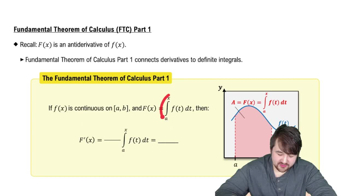
The Fundamental Theorem of Calculus links differentiation and integration, stating that if F is an antiderivative of f on an interval [a, b], then the integral of f from a to b can be computed as F(b) - F(a). This theorem also implies that the derivative of an integral function is the integrand evaluated at the upper limit of integration, which is crucial for simplifying expressions involving derivatives of integrals.
Recommended video:
06:11
Fundamental Theorem of Calculus Part 1

Definite Integral

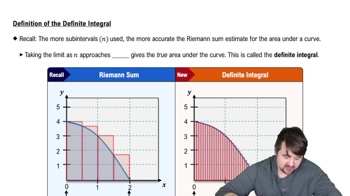
A definite integral represents the signed area under a curve defined by a function over a specific interval [a, b]. It is denoted as ∫_a^b f(x) dx and provides a numerical value that reflects the accumulation of quantities, such as area or total change, over that interval. Understanding how to evaluate definite integrals is essential for applying the Fundamental Theorem of Calculus.
Recommended video:
05:43
Definition of the Definite Integral

Chain Rule

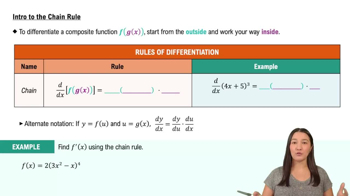
The Chain Rule is a fundamental principle in calculus used to differentiate composite functions. It states that if a function y = f(g(x)) is composed of two functions, the derivative dy/dx can be found by multiplying the derivative of the outer function f with respect to g by the derivative of the inner function g with respect to x. This rule is particularly useful when dealing with integrals that have variable limits, as seen in the given expression.
Recommended video:
05:02
Intro to the Chain Rule
Related Practice
Textbook Question

Definite integrals Evaluate the following integrals using the Fundamental Theorem of Calculus


∫π/₄^³π/⁴ (cot² 𝓍 + 1) d𝓍

1
views

Textbook Question

Use a substitution of the form u = a𝓍 + b to evaluate the following indefinite integrals.

∫(𝓍 + 1)¹² d𝓍

Textbook Question

Areas of regions Find the area of the region bounded by the graph of ƒ and the 𝓍-axis on the given interval.


ƒ(𝓍) = 𝓍³ ― 1 on [―1, 2]

Textbook Question

Approximating displacement The velocity of an object is given by the following functions on a specified interval. Approximate the displacement of the object on this interval by subdividing the interval into n subintervals. Use the left endpoint of each subinterval to compute the height of the rectangles.

{Use of Tech} v = 4 √(t +1) (mi/hr) . for 0 ≤ t ≤ 15 ; n = 5     

1
views
Textbook Question

The composite function ƒ(g(𝓍)) consists of an inner function g and an outer function ƒ. If an integrand includes ƒ(g(𝓍)), which function is often a likely choice for a new variable u?

1
views
Textbook Question

Multiple substitutions If necessary, use two or more substitutions to find the following integrals.                                                                                    


  ∫ 𝓍 sin⁴ 𝓍² cos 𝓍² d𝓍 (Hint: Begin with u = 𝓍², and then use v = sin u .)