Ch. 5 - Integration
Briggs - Calculus: Early Transcendentals 3rd Edition
Briggs3rd EditionCalculus: Early TranscendentalsISBN: 9780136847243Not the one you use?Change textbook
Chapter 5, Problem 5.2.65

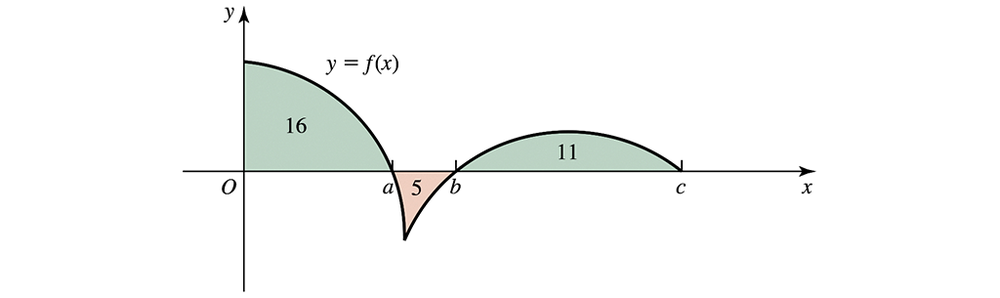
Definite integrals from graphs The figure shows the areas of regions bounded by the graph of ฦ’ and the ๐“-axis. Evaluate the following integrals.
<IMAGE>


โˆซโ‚โฐ ฦ’(๐“) d๐“

Verified step by step guidance
1
Identify the integral to evaluate: \(\int_{a}^{0} f(x) \, dx\). Notice that the limits of integration go from \(a\) to \(0\), which is in the reverse order of the usual left-to-right direction on the x-axis.
Recall the property of definite integrals that reversing the limits changes the sign: \(\int_{a}^{0} f(x) \, dx = -\int_{0}^{a} f(x) \, dx\).
Look at the graph and observe the area between \(x=0\) and \(x=a\). The shaded region above the x-axis has an area of 16, so \(\int_{0}^{a} f(x) \, dx = 16\) because the function is positive there.
Use the property from step 2 to write \(\int_{a}^{0} f(x) \, dx = -16\) since the integral from 0 to a is positive 16 but the limits are reversed.
Thus, the value of the integral \(\int_{a}^{0} f(x) \, dx\) corresponds to the negative of the area between \(0\) and \(a\) under the curve \(f(x)\).

Verified video answer for a similar problem:

This video solution was recommended by our tutors as helpful for the problem above.
Video duration:
2m
Was this helpful?

Key Concepts

Here are the essential concepts you must grasp in order to answer the question correctly.

Definite Integral as Net Area

A definite integral over an interval represents the net area between the function's graph and the x-axis. Areas above the x-axis contribute positively, while areas below contribute negatively. This net area interpretation is essential for evaluating integrals from graphs.
Recommended video:
05:43
Definition of the Definite Integral

Interpreting Areas from Graphs

When given shaded areas on a graph, these represent the absolute values of integrals over subintervals. To find the integral over a larger interval, sum these areas with appropriate signs based on whether the function is above or below the x-axis.
Recommended video:
06:15
Graphing The Derivative

Properties of Definite Integrals and Limits

The integral from a to 0 can be evaluated by reversing limits: โˆซโ‚โฐ f(x) dx = -โˆซโ‚€แตƒ f(x) dx. Understanding how to manipulate integral limits and combine subinterval integrals is crucial for solving problems involving integrals over multiple segments.
Recommended video:
05:43
Definition of the Definite Integral
Related Practice
Textbook Question

Average values Find the average value of the following functions on the given interval. Draw a graph of the function and indicate the average value.

ฦ’(๐“) = ๐“โฟ on [0,1] , for any positive integer n
Textbook Question

Average values Find the average value of the following functions on the given interval. Draw a graph of the function and indicate the average value.

ฦ’(๐“) = ๐“ยณ on [โ€•1, 1]

1
views
Textbook Question

Area versus net area Graph the following functions. Then use geometry (not Riemann sums) to find the area and the net area of the region described.

The region between the graph of y = 1 - |x| and the x-axis, for -2 โ‰ค x โ‰ค 2

1
views
Textbook Question

Definite integrals Evaluate the following integrals using the Fundamental Theorem of Calculus. Sketch the graph of the integrand and shade the region whose net area you have found.                       


 โˆซโ‚€โต (๐“ยฒโ€•9) d๐“ 

Textbook Question

Indefinite integrals Use a change of variables or Table 5.6 to evaluate the following indefinite integrals. Check your work by differentiating.                                                                                  


 โˆซ ๐“eหฃยฒ d๐“

Textbook Question

Indefinite integrals Use a change of variables or Table 5.6 to evaluate the following indefinite integrals. Check your work by differentiating.                                                                                  


 โˆซ ๐“ยณ (๐“โด + 16)โถ d๐“