
Ch. 4 - Applications of the Derivative
Briggs - Calculus: Early Transcendentals 3rd Edition
Briggs3rd EditionCalculus: Early TranscendentalsISBN: 9780136847243Not the one you use?Change textbook
Chapter 4, Problem 56

Verify that the following functions satisfy the conditions of Theorem 4.9 on their domains. Then find the location and value of the absolute extrema guaranteed by the theorem.


f(x) = 4x + 1/√x

Verified step by step guidance
1
Theorem 4.9 is the Extreme Value Theorem, which states that if a function is continuous on a closed interval [a, b], then it must attain an absolute maximum and an absolute minimum on that interval.
First, identify the domain of the function f(x) = 4x + 1/√x. The function is defined for x > 0 because the square root in the denominator requires x to be positive.
Check the continuity of the function on its domain. The function f(x) = 4x + 1/√x is continuous for x > 0, as both terms 4x and 1/√x are continuous for x > 0.
To apply the Extreme Value Theorem, choose a closed interval [a, b] within the domain of f(x). For example, you might choose [1, 2] or any other interval where x > 0.
Find the absolute extrema by evaluating the function at the endpoints of the chosen interval and finding critical points within the interval. Critical points occur where the derivative f'(x) is zero or undefined. Calculate f'(x), set it to zero, and solve for x to find critical points.

Verified video answer for a similar problem:

This video solution was recommended by our tutors as helpful for the problem above.
Video duration:
6m
Was this helpful?

Key Concepts

Here are the essential concepts you must grasp in order to answer the question correctly.

Theorem 4.9 (Extreme Value Theorem)

The Extreme Value Theorem states that if a function is continuous on a closed interval [a, b], then it must attain both a maximum and a minimum value at least once within that interval. This theorem is crucial for identifying absolute extrema, as it provides the conditions under which these extrema exist.
Recommended video:
06:11
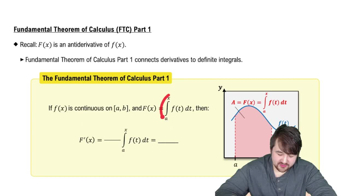
Fundamental Theorem of Calculus Part 1

Continuity of Functions

A function is continuous at a point if the limit of the function as it approaches that point equals the function's value at that point. For the Extreme Value Theorem to apply, the function must be continuous over the specified domain, which ensures that there are no breaks, jumps, or asymptotes that could prevent the function from reaching its extrema.
Recommended video:
05:34
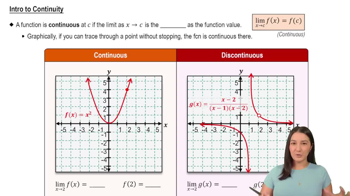
Intro to Continuity

Finding Extrema

To find the absolute extrema of a function, one typically needs to evaluate the function at critical points (where the derivative is zero or undefined) and at the endpoints of the interval. This process involves taking the derivative, setting it to zero to find critical points, and then comparing the function values at these points and the endpoints to determine the absolute maximum and minimum.
Recommended video:
05:58
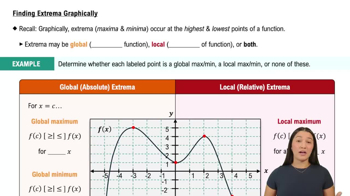
Finding Extrema Graphically
Related Practice
Textbook Question

Growth rate of bamboo Bamboo belongs to the grass family and is one of the fastest growing plants in the world.


b. Based on the Mean Value Theorem, what can you conclude about the instantaneous growth rate of bamboo measured in millimeters per second between 10:00 A.M. and 3:00 P.M.?

1
views
Textbook Question

Growth rate of bamboo Bamboo belongs to the grass family and is one of the fastest growing plants in the world.


a. A bamboo shoot was 500 cm tall at 10:00 A.M. and 515 cm tall at 3:00 P.M. Compute the average growth rate of the bamboo shoot in cm/hr over the period of time from 10:00 A.M. to 3:00 P.M.

Textbook Question

{Use of Tech} Approximating reciprocals To approximate the reciprocal of a number a without using division, we can apply Newton’s method to the function f(x) = 1/x - a. 

b. Apply Newton’s method with a = 7 using a starting value of your choice. Compute an approximation with eight digits of accuracy. What number does Newton’s method approximate in this case?  

Textbook Question

{Use of Tech} Modified Newton’s method The function f has a root of multiplicity 2 at r if f(r) = f'(r) = 0 and f"(r) ≠ 0. In this case, a slight modification of Newton’s method, known as the modified (or accelerated) Newton’s method, is given by the formula xₙ + 1 = xₙ - (2f(xₙ)/(f'(xₙ), for n = 0, 1, 2, . . . . This modified form generally increases the rate of convergence.

b. Apply Newton’s method and the modified Newton’s method using x₀ = 0.1 to find the value of x₃ in each case. Compare the accuracy of these values of x₃.

Textbook Question

Evaluate the following limits in two different ways: with and without l’Hôpital’s Rule.

lim_x→∞ (2x⁵ - x + 1) / (5x⁶ + x)

Textbook Question

{Use of Tech} Flow from a tank A cylindrical tank is full at time t=0 when a valve in the bottom of the tank is opened. By Torricelli’s law, the volume of water in the tank after t hours is V=100(200−t)², measured in cubic meters.

c. Find the rate at which water flows from the tank and plot the flow rate function.