Give the antiderivatives of 1/x.
Ch. 4 - Applications of the Derivative
Briggs3rd EditionCalculus: Early TranscendentalsISBN: 9780136847243Not the one you use?Change textbook
Chapter 4, Problem 4.4.77
{Use of Tech} Special curves The following classical curves have been studied by generations of mathematicians. Use analytical methods (including implicit differentiation) and a graphing utility to graph the curves. Include as much detail as possible.
x⁴ - x² + y² = 0 (Figure-8 curve)
Verified step by step guidance1
Start by understanding the equation of the curve: \(x^4 - x^2 + y^2 = 0\). This is known as the Figure-8 curve due to its shape.
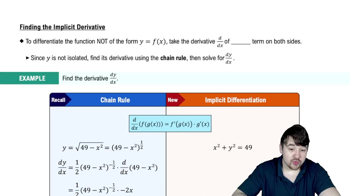
To analyze the curve, we can use implicit differentiation. Differentiate both sides of the equation with respect to \(x\). Remember that \(y\) is a function of \(x\), so when differentiating \(y^2\), apply the chain rule.
The differentiation of \(x^4\) with respect to \(x\) is \(4x^3\), and the differentiation of \(-x^2\) is \(-2x\). For \(y^2\), use the chain rule: \(2y \frac{dy}{dx}\). Set the derivative of the entire equation to zero: \(4x^3 - 2x + 2y \frac{dy}{dx} = 0\).
Solve for \(\frac{dy}{dx}\) to find the slope of the tangent line at any point on the curve. Rearrange the equation to isolate \(\frac{dy}{dx}\): \(\frac{dy}{dx} = \frac{2x - 4x^3}{2y}\). This gives the rate of change of \(y\) with respect to \(x\).
Use a graphing utility to plot the curve \(x^4 - x^2 + y^2 = 0\). Observe the symmetry and the figure-8 shape. Analyze the behavior of the curve at critical points, such as where \(x = 0\) or \(y = 0\), to understand its structure and features.

Verified video answer for a similar problem:
This video solution was recommended by our tutors as helpful for the problem above.
Video duration:
10mWas this helpful?
Key Concepts
Here are the essential concepts you must grasp in order to answer the question correctly.
Implicit Differentiation
Implicit differentiation is a technique used to find the derivative of a function defined implicitly by an equation involving both x and y. Instead of solving for y explicitly, we differentiate both sides of the equation with respect to x, applying the chain rule when differentiating y terms. This method is particularly useful for curves that cannot be easily expressed as y = f(x).
Recommended video:
Finding The Implicit Derivative
Graphing Utility
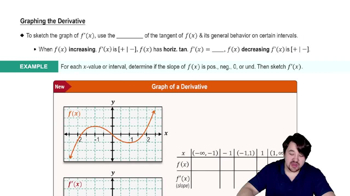
A graphing utility is a software tool or calculator that allows users to visualize mathematical functions and equations. It can plot curves, analyze their properties, and provide insights into their behavior. For the given equation, a graphing utility can help illustrate the shape of the figure-8 curve, making it easier to understand its characteristics and intersections.
Recommended video:
Graphing The Derivative
Classical Curves
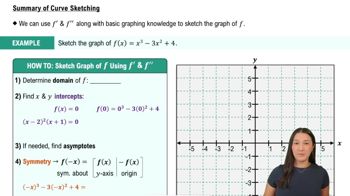
Classical curves refer to well-studied mathematical shapes that have significant historical and theoretical importance, such as conics, cycloids, and the figure-8 curve. These curves often arise in various fields of mathematics and physics, and their properties, such as symmetry and continuity, are essential for understanding their behavior. The figure-8 curve, defined by the equation x⁴ - x² + y² = 0, is an example of a classical curve that exhibits interesting geometric features.
Recommended video:
Summary of Curve Sketching
Related Practice
Textbook Question
Textbook Question
23–68. Indefinite integrals Determine the following indefinite integrals. Check your work by differentiation.
∫ (csc² Θ + 2Θ² - 3Θ) dΘ
Textbook Question
{Use of Tech} Finding all roots Use Newton’s method to find all the roots of the following functions. Use preliminary analysis and graphing to determine good initial approximations.
f(x) = cos 2x - x² + 2x
Textbook Question
Increasing and decreasing functions. Find the intervals on which f is increasing and the intervals on which it is decreasing.
f(x) = cos² x on [-π,π]
1
views
Textbook Question
23–68. Indefinite integrals Determine the following indefinite integrals. Check your work by differentiation.
∫ (3x ¹⸍³ + 4x ⁻¹⸍³ + 6) dx
Textbook Question
17–83. Limits Evaluate the following limits. Use l’Hôpital’s Rule when it is convenient and applicable.
lim_x→∞ (e¹/ₓ - 1)/(1/x)
1
views