
Ch. 4 - Applications of the Derivative
Briggs - Calculus: Early Transcendentals 3rd Edition
Briggs3rd EditionCalculus: Early TranscendentalsISBN: 9780136847243Not the one you use?Change textbook
Chapter 4, Problem 4.4.74

{Use of Tech} Special curves The following classical curves have been studied by generations of mathematicians. Use analytical methods (including implicit differentiation) and a graphing utility to graph the curves. Include as much detail as possible.


y = 8/(x² + 4) (Witch of Agnesi)

Verified step by step guidance
1
Identify the given equation of the curve: \( y = \frac{8}{x^2 + 4} \). This is known as the Witch of Agnesi.
To analyze the curve, find the first derivative \( \frac{dy}{dx} \) using implicit differentiation. Start by rewriting the equation in a form suitable for differentiation: \( y(x^2 + 4) = 8 \).
Differentiate both sides with respect to \( x \). Use the product rule on the left side: \( \frac{d}{dx}[y(x^2 + 4)] = \frac{d}{dx}[8] \). This gives \( y' (x^2 + 4) + y(2x) = 0 \).
Solve for \( y' \) to find the slope of the tangent line at any point \( x \): \( y' = -\frac{y(2x)}{x^2 + 4} \). Substitute \( y = \frac{8}{x^2 + 4} \) into this expression to get \( y' = -\frac{16x}{(x^2 + 4)^2} \).
Use a graphing utility to plot the curve \( y = \frac{8}{x^2 + 4} \). Observe the symmetry about the y-axis and note the behavior as \( x \to \pm \infty \) and \( x = 0 \). The curve approaches the x-axis but never touches it, and it has a maximum at \( x = 0 \).

Verified video answer for a similar problem:

This video solution was recommended by our tutors as helpful for the problem above.
Video duration:
9m
Was this helpful?

Key Concepts

Here are the essential concepts you must grasp in order to answer the question correctly.

Implicit Differentiation

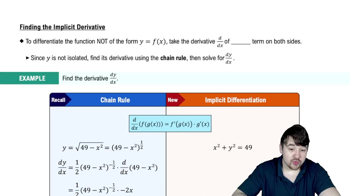
Implicit differentiation is a technique used to differentiate equations that define y implicitly in terms of x, rather than explicitly as y = f(x). This method is particularly useful when dealing with curves that cannot be easily solved for y. By applying the chain rule and treating y as a function of x, we can find the derivative dy/dx even when y is not isolated.
Recommended video:
05:14
Finding The Implicit Derivative

Graphing Utility

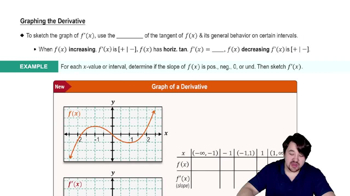
A graphing utility is a software tool or calculator that allows users to visualize mathematical functions and curves. It can plot equations, analyze their behavior, and provide insights into their properties, such as intercepts, asymptotes, and symmetry. Utilizing a graphing utility is essential for understanding the shape and characteristics of complex curves like the Witch of Agnesi.
Recommended video:
06:15
Graphing The Derivative

Classical Curves

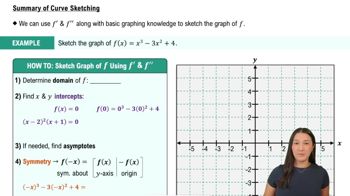
Classical curves refer to well-studied mathematical curves that have significant historical and theoretical importance, such as the Witch of Agnesi. These curves often arise in various applications, including physics and engineering, and are characterized by specific equations. Understanding their properties, such as symmetry and asymptotic behavior, is crucial for analyzing their graphical representations.
Recommended video:
11:41
Summary of Curve Sketching