Ch. 4 - Applications of the Derivative
Briggs - Calculus: Early Transcendentals 3rd Edition
Briggs3rd EditionCalculus: Early TranscendentalsISBN: 9780136847243Not the one you use?Change textbook
Chapter 4, Problem 4.20.1

{Use of Tech} Finding all roots Use Newton’s method to find all the roots of the following functions. Use preliminary analysis and graphing to determine good initial approximations.


f(x) = cos x - x/7

Verified step by step guidance
1
Start by performing a preliminary analysis of the function \( f(x) = \cos x - \frac{x}{7} \). Consider the behavior of \( \cos x \) and \( -\frac{x}{7} \) to understand where the function might cross the x-axis.
Graph the function \( f(x) = \cos x - \frac{x}{7} \) to visually identify approximate locations of the roots. Look for points where the graph intersects the x-axis.
Choose initial approximations for the roots based on the graph. These are the x-values where the function appears to cross the x-axis.
Apply Newton's method, which uses the formula \( x_{n+1} = x_n - \frac{f(x_n)}{f'(x_n)} \), where \( f'(x) = -\sin x - \frac{1}{7} \). Calculate \( f'(x) \) for the function.
Iteratively apply Newton's method using the initial approximations. For each iteration, compute the next approximation until the values converge to a stable root. Repeat this process for each initial approximation to find all roots.

Verified video answer for a similar problem:

This video solution was recommended by our tutors as helpful for the problem above.
Video duration:
6m
Was this helpful?

Key Concepts

Here are the essential concepts you must grasp in order to answer the question correctly.

Newton's Method

Newton's Method is an iterative numerical technique used to find approximate roots of a real-valued function. It starts with an initial guess and refines it using the formula x_{n+1} = x_n - f(x_n)/f'(x_n), where f' is the derivative of f. This method converges quickly if the initial guess is close to the actual root and the function behaves well.
Recommended video:
4:26
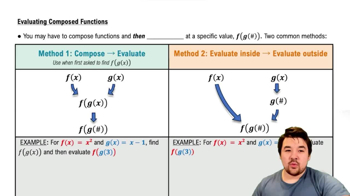
Evaluating Composed Functions

Preliminary Analysis

Preliminary analysis involves examining the function's behavior to identify potential roots before applying numerical methods. This can include evaluating the function at various points, checking for sign changes, and analyzing critical points. Understanding the function's continuity and differentiability is crucial for effective root-finding.
Recommended video:
06:29
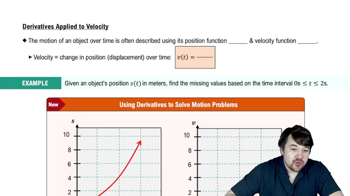
Derivatives Applied To Velocity

Graphing Functions

Graphing functions provides a visual representation of their behavior, helping to identify where roots may lie. By plotting the function, one can observe intersections with the x-axis, which indicate potential roots. This visual approach aids in selecting appropriate initial approximations for methods like Newton's Method.
Recommended video:
5:53
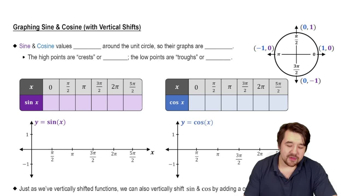
Graph of Sine and Cosine Function