
Textbook Question
Explain why or why not Determine whether the following statements are true and give an explanation or counterexample.
a. The function f(x) = √x has a local maximum on the interval [0,∞).

 Verified step by step guidance
 03:07
03:07
 5:53
5:53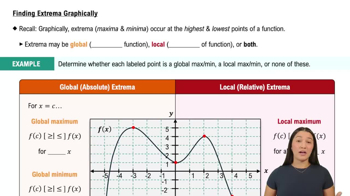 05:58
05:58Explain why or why not Determine whether the following statements are true and give an explanation or counterexample.
a. The function f(x) = √x has a local maximum on the interval [0,∞).
{Use of Tech} Basketball shot A basketball is shot with an initial velocity of v ft/s at an angle of 45° to the floor. The center of the basketball is 8 ft above the floor at a horizontal distance of 18 feet from the center of the basketball hoop when it is released. The height h (in feet) of the center of the basketball after it has traveled a horizontal distance of x feet is modeled by the function h(x) = 32x² / v² + x + 8 (see figure). <IMAGE>
b. During the flight of the basketball, show that the distance s from the center of the basketball to the front of the hoop is s = √ (x - 17.25)² + ( -(4x² / 81) + x - 2)² (Hint: The diameter of the basketball hoop is 18 inches.)
Values of related functions Suppose f is differentiable on (-∞,∞) and assume it has a local extreme value at the point x = 2, where f(2) = 0. Let g(x) = xf(x) + 1 and let h(x) = xf(x) + x +1, for all values of x.
a. Evaluate g(2), h(2), g'(2), and h'(2).
Values of related functions Suppose f is differentiable on (-∞,∞) and assume it has a local extreme value at the point x = 2, where f(2) = 0. Let g(x) = xf(x) + 1 and let h(x) = xf(x) + x +1, for all values of x.
b. Does either g or h have a local extreme value at x = 2? Explain.
{Use of Tech} Elliptic curves The equation y² = x³ - ax + 3, where a is a parameter, defines a well-known family of elliptic curves.
a. Plot a graph of the curve when a = 3.
{Use of Tech} Let f(x) = ln((x+1)/(x-1)) and g(x) = ln ((x+1)/(x-1)).
b. Sketch graphs of f and g to show that these functions do not differ by a constant.