
Ch. 4 - Applications of the Derivative
Briggs - Calculus: Early Transcendentals 3rd Edition
Briggs3rd EditionCalculus: Early TranscendentalsISBN: 9780136847243Not the one you use?Change textbook
Chapter 4, Problem 46

Suppose you own a tour bus and you book groups of 20 to 70 people for a day tour. The cost per person is \$30 minus \$0.25 for every ticket sold. If gas and other miscellaneous costs are \$200, how many tickets should you sell to maximize your profit? Treat the number of tickets as a nonnegative real number.

Verified step by step guidance
1
Define the variables: Let x be the number of tickets sold. The cost per person is given by the expression \(30 - 0.25x\).
Write the revenue function: The revenue R(x) is the product of the number of tickets sold and the cost per person, so R(x) = x * (30 - 0.25x).
Write the cost function: The total cost C(x) is the sum of the fixed costs, which is \$200, so C(x) = 200.
Write the profit function: The profit P(x) is the revenue minus the cost, so P(x) = R(x) - C(x) = x * (30 - 0.25x) - 200.
Find the maximum profit: To maximize the profit, take the derivative of P(x) with respect to x, set it equal to zero, and solve for x. This will give the number of tickets that should be sold to maximize profit.

Verified video answer for a similar problem:

This video solution was recommended by our tutors as helpful for the problem above.
Video duration:
5m
Was this helpful?

Key Concepts

Here are the essential concepts you must grasp in order to answer the question correctly.

Profit Function

The profit function represents the difference between total revenue and total costs. In this scenario, the revenue is derived from ticket sales, calculated as the number of tickets sold multiplied by the price per ticket. The costs include fixed expenses, such as gas and miscellaneous costs. Understanding how to formulate and analyze this function is crucial for determining the optimal number of tickets to sell.
Recommended video:
07:32
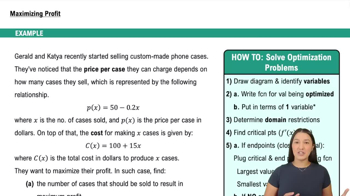
Example 3: Maximizing Profit

Revenue Maximization

Revenue maximization involves finding the number of tickets sold that generates the highest possible income. The price per ticket decreases as more tickets are sold, creating a relationship between quantity sold and price. This concept is essential for setting up the revenue equation, which is influenced by the number of tickets sold and the corresponding price adjustments.
Recommended video:
04:18
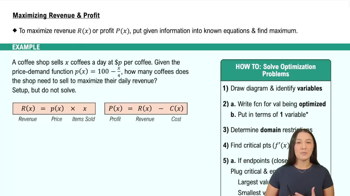
Maximizing Profit & Revenue

Optimization Techniques

Optimization techniques, particularly calculus, are used to find maximum or minimum values of functions. In this problem, you would typically take the derivative of the profit function and set it to zero to find critical points. Analyzing these points helps determine the number of tickets that maximizes profit, ensuring that the solution is both feasible and aligns with the constraints of the problem.
Recommended video:
10:13
Intro to Applied Optimization: Maximizing Area