
Ch. 4 - Applications of the Derivative
Briggs - Calculus: Early Transcendentals 3rd Edition
Briggs3rd EditionCalculus: Early TranscendentalsISBN: 9780136847243Not the one you use?Change textbook
Chapter 4, Problem 4.5.6b

Suppose S = x + 2y is an objective function subject to the constraint xy = 50, for x > 0 and y > 0.
b. Find the absolute minimum value of S subject to the given constraint.

Verified step by step guidance
1
First, express the constraint equation xy = 50 in terms of one variable. Solve for y in terms of x: y = 50/x.
Substitute y = 50/x into the objective function S = x + 2y to express S in terms of x alone: S = x + 2(50/x).
Simplify the expression for S: S = x + 100/x.
To find the critical points, take the derivative of S with respect to x. Use the power rule and the derivative of x^(-1) to find dS/dx.
Set the derivative dS/dx equal to zero and solve for x to find the critical points. Check these points to determine the absolute minimum value of S.

Verified video answer for a similar problem:

This video solution was recommended by our tutors as helpful for the problem above.
Video duration:
6m
Was this helpful?

Key Concepts

Here are the essential concepts you must grasp in order to answer the question correctly.

Objective Function

An objective function is a mathematical expression that defines a quantity to be maximized or minimized. In this case, S = x + 2y is the objective function, which we aim to minimize while adhering to certain constraints. Understanding how to manipulate and evaluate this function is crucial for finding optimal solutions.
Recommended video:
06:21
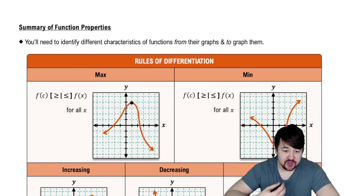
Properties of Functions

Constraints

Constraints are conditions that the variables in an optimization problem must satisfy. Here, the constraint xy = 50 restricts the values of x and y, ensuring they remain positive. Recognizing how constraints affect the feasible region is essential for determining the minimum value of the objective function.
Recommended video:
10:13
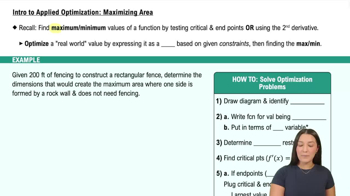
Intro to Applied Optimization: Maximizing Area

Lagrange Multipliers

Lagrange multipliers are a method used in optimization to find the local maxima and minima of a function subject to equality constraints. This technique involves introducing a new variable (the multiplier) to incorporate the constraint into the optimization process. Applying this method will help in finding the absolute minimum value of S under the given constraint.
Recommended video:
7:24
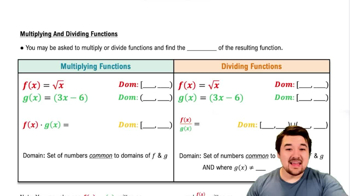
Multiplying & Dividing Functions
Related Practice
Textbook Question

107–110. {Use of Tech} Motion with gravity Consider the following descriptions of the vertical motion of an object subject only to the acceleration due to gravity. Begin with the acceleration equation a(t) = v' (t) = -g , where g = 9.8 m/s² .

b. Find the position of the object for all relevant times. 

A payload is released at an elevation of 400 m from a hot-air balloon that is rising at a rate of 10 m/s.

1
views
Textbook Question

{Use of Tech} A damped oscillator The displacement of an object as it bounces vertically up and down on a spring is given by y(t) = 2.5e⁻ᵗ cos 2t, where the initial displacement is y(0) = 2.5 and y = 0 corresponds to the rest position (see figure). <IMAGE>


c. Find the time at which the object passes the rest position for the second time.

1
views
Textbook Question

Population models The population of a species is given by the function P(t) = Kt²/(t² + b) , where t ≥ 0 is measured in years and K and b are positive real numbers.


c. For arbitrary positive values of K and b, when does the maximum growth rate occur (in terms of K and b)?

Textbook Question

{Use of Tech} Fixed points of quadratics and quartics Let f(x) = ax(1 -x), where a is a real number and 0 ≤ a ≤ 1. Recall that the fixed point of a function is a value of x such that f(x) = x (Exercises 48–51). 


b. Consider the polynomial g(x) = f(f(x)). Write g in terms of a and powers of x. What is its degree?

Textbook Question

{Use of Tech} Demand functions and elasticity Economists use demand functions to describe how much of a commodity can be sold at varying prices. For example, the demand function D(p) = 500 - 10p says that at a price of p = 10, a quantity of D(10) = 400 units of the commodity can be sold. The elasticity E = dD/dp p/D of the demand gives the approximate percent change in the demand for every 1% change in the price. (See Section 3.6 or the Guided Project Elasticity in Economics for more on demand functions and elasticity.)


b. If the price is \$12 and increases by 4.5%, what is the approximate percent change in the demand? 

1
views
Textbook Question

Explain why or why not Determine whether the following statements are true and give an explanation or counterexample.


c. If f(x) = mx + b, then the linear approximation to f at any point is L(x) = f(x).