
Textbook Question
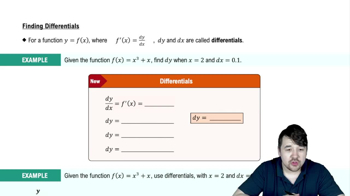
Differentials Consider the following functions and express the relationship between a small change in x and the corresponding change in y in the form dy = f'(x)dx.
f(x) = sin² x

 Verified step by step guidance
 05:53
05:53
 07:17
07:17 05:44
05:44Differentials Consider the following functions and express the relationship between a small change in x and the corresponding change in y in the form dy = f'(x)dx.
f(x) = sin² x
Sketch a continuous function f on some interval that has the properties described. Answers will vary.
The function f satisfies f'(-2) = 2, f'(0) = 0, f'(1) = -3 and f'(4) = 1.
17–83. Limits Evaluate the following limits. Use l’Hôpital’s Rule when it is convenient and applicable.
lim_x→1⁻ (1-x) tan πx/2
Second Derivative Test Locate the critical points of the following functions. Then use the Second Derivative Test to determine (if possible) whether they correspond to local maxima or local minima.
f(x) = 2x⁻³ - x⁻²
Use the following graphs to identify the points on the interval [a, b] at which local and absolute extreme values occur. <IMAGE>
Suppose the position of an object moving horizontally after seconds is given by the function s(t) = 32t - t⁴, where 0 ≤ t ≤ 3 and s is measured in feet, with s > 0 corresponding to positions to the right of the origin. When is the object farthest to the right?