Ch. 4 - Applications of the Derivative
Briggs - Calculus: Early Transcendentals 3rd Edition
Briggs3rd EditionCalculus: Early TranscendentalsISBN: 9780136847243Not the one you use?Change textbook
Chapter 4, Problem 4.9.79

Solving initial value problems Find the solution of the following initial value problems.
g'(x) = 7x(x⁶ - 1/7); g(1) = 2

Verified step by step guidance
1
Step 1: Recognize that this is an initial value problem, which involves finding a function g(x) such that its derivative matches the given expression g'(x) = 7x(x⁶ - 1/7) and satisfies the initial condition g(1) = 2.
Step 2: To find g(x), integrate the derivative g'(x). Set up the integral: ∫7x(x⁶ - 1/7) dx. Break this into two terms: ∫7x * x⁶ dx - ∫7x * (1/7) dx.
Step 3: Compute each integral separately. For the first term, ∫7x * x⁶ dx, rewrite it as ∫7x⁷ dx and use the power rule for integration: ∫xⁿ dx = (xⁿ⁺¹)/(n+1). For the second term, ∫7x * (1/7) dx, simplify to ∫x dx and apply the power rule.
Step 4: Combine the results of the two integrals to form the general solution g(x). Add the constant of integration C to account for the indefinite integral.
Step 5: Use the initial condition g(1) = 2 to solve for the constant C. Substitute x = 1 into the general solution g(x) and set it equal to 2. Solve for C to find the specific solution that satisfies the initial value problem.

Verified video answer for a similar problem:

This video solution was recommended by our tutors as helpful for the problem above.
Video duration:
2m
Was this helpful?

Key Concepts

Here are the essential concepts you must grasp in order to answer the question correctly.

Differentiation

Differentiation is the process of finding the derivative of a function, which represents the rate of change of the function with respect to its variable. In the context of the given problem, g'(x) = 7x(x⁶ - 1/7) indicates that we need to understand how to differentiate functions to find g(x) from its derivative.
Recommended video:
05:53
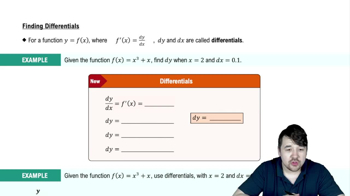
Finding Differentials

Integration

Integration is the reverse process of differentiation and is used to find the original function from its derivative. To solve the initial value problem, we will integrate g'(x) to find g(x), which involves applying techniques such as substitution or integration by parts, depending on the complexity of the function.
Recommended video:
06:18
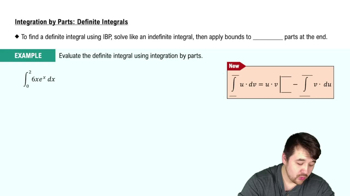
Integration by Parts for Definite Integrals

Initial Value Problem

An initial value problem (IVP) is a type of differential equation that includes a condition specifying the value of the function at a particular point. In this case, g(1) = 2 provides a specific value that allows us to determine the constant of integration after finding the general solution of g(x), ensuring that our solution satisfies the given condition.
Recommended video:
05:03
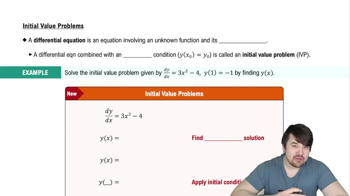
Initial Value Problems