
Ch. 4 - Applications of the Derivative
Briggs - Calculus: Early Transcendentals 3rd Edition
Briggs3rd EditionCalculus: Early TranscendentalsISBN: 9780136847243Not the one you use?Change textbook
Chapter 4, Problem 4.4.8d

Sketch a graph of a function f with the following properties.


f' < 0 and f" < 0, for 8 < x < 10

Verified step by step guidance
1
Understand the given conditions: f'(x) < 0 means the function f is decreasing in the interval 8 < x < 10, and f''(x) < 0 means the function is concave down in the same interval.
Visualize the behavior of the function: Since f'(x) < 0, the slope of the tangent line to the graph of f is negative, indicating that the graph is sloping downward. Additionally, f''(x) < 0 implies that the graph is curving downward, resembling a 'downward bowl' shape.
Sketch the graph in the interval 8 < x < 10: Start by drawing a curve that decreases (slopes downward) and is concave down. Ensure the curve does not flatten or change concavity within this interval.
Consider the behavior outside the interval: While the problem does not specify the behavior of f for x ≤ 8 or x ≥ 10, ensure the graph transitions smoothly into the interval 8 < x < 10 without abrupt changes.
Label the graph appropriately: Mark the interval 8 < x < 10 on the x-axis and ensure the graph clearly reflects the properties f'(x) < 0 and f''(x) < 0 within this interval.

Verified video answer for a similar problem:

This video solution was recommended by our tutors as helpful for the problem above.
Video duration:
2m
Was this helpful?

Key Concepts

Here are the essential concepts you must grasp in order to answer the question correctly.

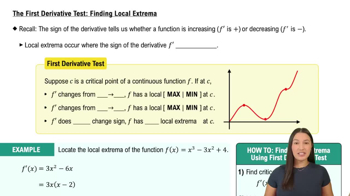
First Derivative Test

The first derivative of a function, denoted as f', indicates the slope of the tangent line to the graph at any point. If f' < 0, the function is decreasing in that interval. Understanding this concept is crucial for sketching the graph, as it informs us that the function is moving downward between x = 8 and x = 10.
Recommended video:
07:09
The First Derivative Test: Finding Local Extrema

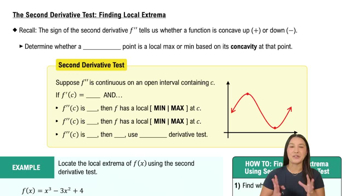
Second Derivative Test

The second derivative, denoted as f'', provides information about the concavity of the function. If f'' < 0, the function is concave down, meaning that the slope of the tangent line is decreasing. This concept is essential for sketching the graph, as it indicates that the function not only decreases but does so at an accelerating rate in the specified interval.
Recommended video:
06:02
The Second Derivative Test: Finding Local Extrema

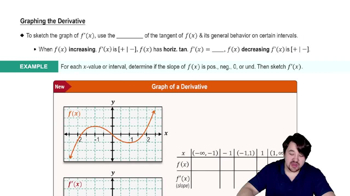
Graph Behavior

Understanding the overall behavior of a function based on its derivatives is key to sketching its graph. In this case, since f' < 0 and f'' < 0 for 8 < x < 10, the graph will show a downward slope that becomes steeper as x increases. This behavior helps in accurately representing the function's characteristics in the specified interval.
Recommended video:
06:15
Graphing The Derivative
Related Practice
Textbook Question

{Use of Tech} Fixed points of quadratics and quartics Let f(x) = ax(1 -x), where a is a real number and 0 ≤ a ≤ 1. Recall that the fixed point of a function is a value of x such that f(x) = x (Exercises 48–51). 


d. Find the number and location of the fixed points of g for a = 2, 3, and 4 on the interval 0 ≤ x ≤ 1. 

Textbook Question

107–110. {Use of Tech} Motion with gravity Consider the following descriptions of the vertical motion of an object subject only to the acceleration due to gravity. Begin with the acceleration equation a(t) = v' (t) = -g , where g = 9.8 m/s² .

d. Find the time when the object strikes the ground.

A payload is released at an elevation of 400 m from a hot-air balloon that is rising at a rate of 10 m/s.

Textbook Question

if ƒ(x) = 1 / (3x⁴ + 5) , it can be shown that ƒ'(x) = 12x³ / (3x⁴ + 5)² and ƒ"(x) = 180x² (x² + 1) (x + 1) (x - 1) / (3x⁴ + 5)³ . Use these functions to complete the following steps.


d. Identify the local extreme values and inflection points of ƒ .

Textbook Question

Interpreting the derivative The graph of f' on the interval [-3,2] is shown in the figure. <IMAGE>


f. Sketch one possible graph of f.

Textbook Question

Rectangles in triangles Find the dimensions and area of the rectangle of maximum area that can be inscribed in the following figures.

d. An arbitrary triangle with a given area A (The result applies to any triangle, but first consider triangles for which all the angles are less than or equal to 90° .)

Textbook Question

{Use of Tech} A damped oscillator The displacement of an object as it bounces vertically up and down on a spring is given by y(t) = 2.5e⁻ᵗ cos 2t, where the initial displacement is y(0) = 2.5 and y = 0 corresponds to the rest position (see figure). <IMAGE>


d. Find the time and the displacement when the object reaches its high point for the second time.

1
views