
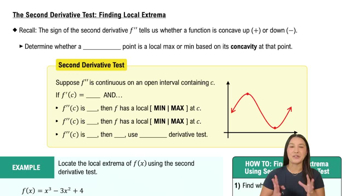
Second Derivative Test Locate the critical points of the following functions. Then use the Second Derivative Test to determine (if possible) whether they correspond to local maxima or local minima.
f(x) = 6x² - x³
Verified step by step guidance
Second Derivative Test Locate the critical points of the following functions. Then use the Second Derivative Test to determine (if possible) whether they correspond to local maxima or local minima.
f(x) = 6x² - x³
17–83. Limits Evaluate the following limits. Use l’Hôpital’s Rule when it is convenient and applicable.
lim_x→π (cos x +1 ) / (x - π )²
Sketch the graph of a continuous function ƒ on [0, 4] satisfying the given properties.
ƒ' (x) and ƒ'3 are undefined; ƒ'(2) = 0; has a local maximum at x= 1; ƒ has local minimum at x = 2; and ƒ has an absolute maximum at x= 3; and ƒ has an absolute minimum at x = 4 .
A car starting at rest accelerates at 16 ft/s² for 5 seconds on a straight road. How far does it travel during this time?
{Use of Tech} A pursuit curve A man stands 1 mi east of a crossroads. At noon, a dog starts walking north from the crossroads at 1 mi/hr (see figure). At the same instant, the man starts walking and at all times walks directly toward the dog at s > 1 mi/hr . The path in the xy-plane followed by the man as he pursues the dog is given by the function y = ƒ(x) = s/2 ((x(ˢ⁺¹)/ˢ) /(s+1) - (x(ˢ⁺¹)/ˢ / s-1)) + s/ s² - 1
Select various values of s > 1 and graph this pursuit curve. Comment on the changes in the curve as s increases. <IMAGE>
Increasing and decreasing functions. Find the intervals on which f is increasing and the intervals on which it is decreasing.
f(x) = tan⁻¹ (x/(x²+2))