
Ch. 4 - Applications of the Derivative
Briggs - Calculus: Early Transcendentals 3rd Edition
Briggs3rd EditionCalculus: Early TranscendentalsISBN: 9780136847243Not the one you use?Change textbook
Chapter 4, Problem 53b

Mean Value Theorem The population of a culture of cells grows according to the function P(t) = 100t / t+1, where t ≥ 0 is measured in weeks.


b. At what point of the interval [0, 8] is the instantaneous rate of change equal to the average rate of change?

Verified step by step guidance
1
First, understand the Mean Value Theorem (MVT). It states that for a function continuous on [a, b] and differentiable on (a, b), there exists at least one point c in (a, b) such that the derivative at c is equal to the average rate of change over [a, b].
Calculate the average rate of change of the function P(t) = \( \frac{100t}{t+1} \) over the interval [0, 8]. This is given by \( \frac{P(8) - P(0)}{8 - 0} \).
Find P(0) and P(8) by substituting t = 0 and t = 8 into the function P(t). This will give you the values needed to compute the average rate of change.
Next, find the derivative of the function P(t) = \( \frac{100t}{t+1} \). Use the quotient rule, which states that if you have a function \( \frac{u}{v} \), its derivative is \( \frac{u'v - uv'}{v^2} \).
Set the derivative equal to the average rate of change calculated earlier and solve for t. This will give you the point c in the interval [0, 8] where the instantaneous rate of change equals the average rate of change.

Verified video answer for a similar problem:

This video solution was recommended by our tutors as helpful for the problem above.
Video duration:
11m
Was this helpful?

Key Concepts

Here are the essential concepts you must grasp in order to answer the question correctly.

Mean Value Theorem

The Mean Value Theorem states that if a function is continuous on a closed interval [a, b] and differentiable on the open interval (a, b), then there exists at least one point c in (a, b) where the instantaneous rate of change (the derivative) equals the average rate of change over that interval. This theorem is fundamental in connecting the behavior of a function to its derivative.
Recommended video:
06:11
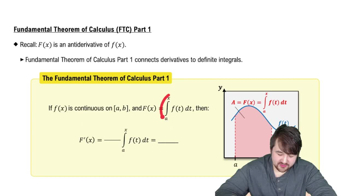
Fundamental Theorem of Calculus Part 1

Instantaneous Rate of Change

The instantaneous rate of change of a function at a point is defined as the derivative of the function at that point. It represents how the function value changes at that specific moment, providing insight into the function's behavior. For the given function P(t), this would involve calculating P'(t) to find the rate of change at any time t.
Recommended video:
04:16
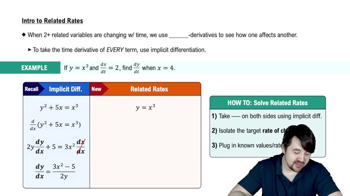
Intro To Related Rates

Average Rate of Change

The average rate of change of a function over an interval [a, b] is calculated as the difference in the function values at the endpoints divided by the difference in the input values, expressed as (P(b) - P(a)) / (b - a). This concept helps in understanding how the function behaves over a specified range, and is essential for applying the Mean Value Theorem.
Recommended video:
06:37
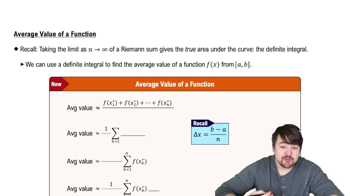
Average Value of a Function
Related Practice
Textbook Question

Growth rate of bamboo Bamboo belongs to the grass family and is one of the fastest growing plants in the world.


b. Based on the Mean Value Theorem, what can you conclude about the instantaneous growth rate of bamboo measured in millimeters per second between 10:00 A.M. and 3:00 P.M.?

1
views
Textbook Question

Growth rate of bamboo Bamboo belongs to the grass family and is one of the fastest growing plants in the world.


a. A bamboo shoot was 500 cm tall at 10:00 A.M. and 515 cm tall at 3:00 P.M. Compute the average growth rate of the bamboo shoot in cm/hr over the period of time from 10:00 A.M. to 3:00 P.M.

Textbook Question

First Derivative Test


a. Locate the critical points of f.

b. Use the First Derivative Test to locate the local maximum and minimum values.

c. Identify the absolute maximum and minimum values of the function on the given interval (when they exist).


f(x) = x - 2 tan⁻¹ x on [-√3,√3)

Textbook Question

First Derivative Test


a. Locate the critical points of f.

b. Use the First Derivative Test to locate the local maximum and minimum values.

c. Identify the absolute maximum and minimum values of the function on the given interval (when they exist).


f(x) = x²/(x² - 1) on [-4,4]

1
views
Textbook Question

First Derivative Test


a. Locate the critical points of f.

b. Use the First Derivative Test to locate the local maximum and minimum values.

c. Identify the absolute maximum and minimum values of the function on the given interval (when they exist).


f(x) = 2x⁵ - 5x⁴ - 10x³ + 4 on [-2,4]

Textbook Question

Mean Value Theorem The population of a culture of cells grows according to the function P(t) = 100t / t+1, where t ≥ 0 is measured in weeks.


a. What is the average rate of change in the population over the interval [0, 8]?