
{Use of Tech } Minimizing sound intensity Two sound speakers are 100 m apart and one speaker is three times as loud as the other speaker. At what point on a line segment between the speakers is the sound intensity the weakest? (Hint: Sound intensity is directly proportional to the sound level and inversely proportional to the square of the distance from the sound source.)
Ch. 4 - Applications of the Derivative
Briggs3rd EditionCalculus: Early TranscendentalsISBN: 9780136847243Not the one you use?Change textbook
Chapter 4, Problem 4.R.2c
Locating extrema Consider the graph of a function ƒ on the interval [-3, 3]. <IMAGE>
c. Give the approximate coordinates of the inflection point(s) of f.
Verified step by step guidance1
Understand that an inflection point is where the function changes concavity, which means the second derivative changes sign.
Examine the graph visually to identify where the curve changes from concave up to concave down or vice versa.
Look for points on the graph where the slope of the tangent line changes from increasing to decreasing or vice versa, indicating a change in concavity.
Estimate the x-coordinate of the inflection point by observing the graph and noting where this change occurs.
Approximate the y-coordinate by finding the corresponding value of the function at the estimated x-coordinate.

Verified video answer for a similar problem:
This video solution was recommended by our tutors as helpful for the problem above.
Video duration:
2mWas this helpful?
Key Concepts
Here are the essential concepts you must grasp in order to answer the question correctly.
Inflection Points
Inflection points are points on the graph of a function where the curvature changes direction. This means that the second derivative of the function changes sign at these points. Identifying inflection points is crucial for understanding the behavior of the function, particularly in determining where it transitions from concave up to concave down or vice versa.
Recommended video:
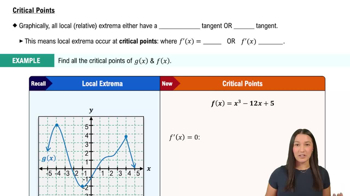
Critical Points
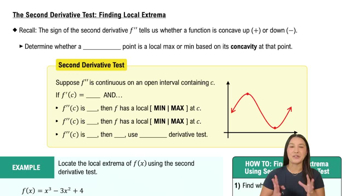
Second Derivative Test
The second derivative test is a method used to determine the concavity of a function at a given point. If the second derivative is positive, the function is concave up, and if it is negative, the function is concave down. An inflection point occurs where the second derivative equals zero or is undefined, indicating a potential change in concavity.
Recommended video:
The Second Derivative Test: Finding Local Extrema
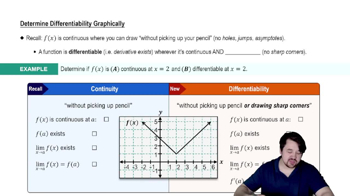
Graphical Analysis
Graphical analysis involves examining the visual representation of a function to identify key features such as extrema, inflection points, and intervals of increase or decrease. By analyzing the graph, one can estimate the coordinates of inflection points and understand the overall behavior of the function across the specified interval.
Recommended video:
Determining Differentiability Graphically
Related Practice
Textbook Question
Textbook Question
{Use of Tech} Newton’s method Use Newton’s method to approximate the roots of ƒ(x) = e⁻²ˣ + 2eˣ - 6 to six digits.
Textbook Question
{Use of Tech} A family of superexponential functions Let ƒ(x) = (a + x)ˣ , where a > 0.
b. Describe the end behavior of f (near the left boundary of its domain and as x→∞).
1
views
Textbook Question
60–81. Limits Evaluate the following limits. Use l’Hôpital’s Rule when needed.
lim_x→0 csc x sin⁻¹ x
Textbook Question
Find the critical points of the following functions on the given intervals. Identify the absolute maximum and absolute minimum values (if they exist).
ƒ(x) = x³ ln x on (0, ∞)
1
views
Textbook Question
90–103. Indefinite integrals Determine the following indefinite integrals.
∫ dx / (1 - sin² x)
