Ch. 4 - Applications of the Derivative
Briggs - Calculus: Early Transcendentals 3rd Edition
Briggs3rd EditionCalculus: Early TranscendentalsISBN: 9780136847243Not the one you use?Change textbook
Chapter 4, Problem 4.1.23

Locating critical points Find the critical points of the following functions. Assume a is a nonzero constant.


ƒ(x) = 3x² - 4x + 2

Verified step by step guidance
1
To find the critical points of the function \( f(x) = 3x^2 - 4x + 2 \), we first need to find its derivative. The derivative, \( f'(x) \), represents the slope of the tangent line to the curve at any point \( x \).
Differentiate the function \( f(x) = 3x^2 - 4x + 2 \) with respect to \( x \). Using the power rule, the derivative of \( 3x^2 \) is \( 6x \), and the derivative of \( -4x \) is \( -4 \). The derivative of a constant, \( 2 \), is \( 0 \). Therefore, \( f'(x) = 6x - 4 \).
Critical points occur where the derivative is zero or undefined. Since \( f'(x) = 6x - 4 \) is a linear function, it is defined for all \( x \). Set the derivative equal to zero to find the critical points: \( 6x - 4 = 0 \).
Solve the equation \( 6x - 4 = 0 \) for \( x \). Add \( 4 \) to both sides to get \( 6x = 4 \). Then, divide both sides by \( 6 \) to isolate \( x \), resulting in \( x = \frac{4}{6} \). Simplify the fraction to get \( x = \frac{2}{3} \).
The critical point of the function \( f(x) = 3x^2 - 4x + 2 \) is at \( x = \frac{2}{3} \). To confirm whether this point is a maximum, minimum, or neither, you can use the second derivative test or analyze the behavior of \( f'(x) \) around \( x = \frac{2}{3} \).

Verified video answer for a similar problem:

This video solution was recommended by our tutors as helpful for the problem above.
Video duration:
3m
Was this helpful?

Key Concepts

Here are the essential concepts you must grasp in order to answer the question correctly.

Critical Points

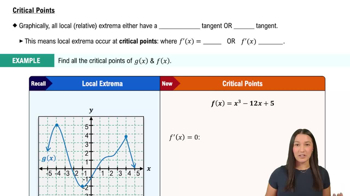
Critical points of a function occur where its derivative is either zero or undefined. These points are essential for identifying local maxima, minima, and points of inflection. To find critical points, one typically takes the derivative of the function and solves for the values of x that satisfy the condition.
Recommended video:
04:50
Critical Points

Derivative

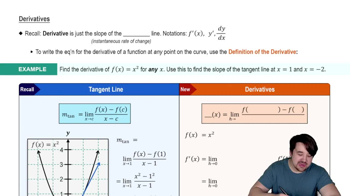
The derivative of a function measures the rate at which the function's value changes as its input changes. It is a fundamental concept in calculus, representing the slope of the tangent line to the curve at any given point. For polynomial functions like ƒ(x) = 3x² - 4x + 2, the derivative can be calculated using power rules.
Recommended video:
05:44
Derivatives

Polynomial Functions

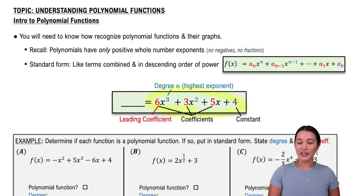
Polynomial functions are expressions that involve variables raised to whole number powers, combined using addition, subtraction, and multiplication. The function given, ƒ(x) = 3x² - 4x + 2, is a quadratic polynomial, which has a parabolic graph. Understanding the properties of polynomial functions is crucial for analyzing their behavior, including finding critical points.
Recommended video:
6:04
Introduction to Polynomial Functions