
Ch. 4 - Applications of the Derivative
Briggs - Calculus: Early Transcendentals 3rd Edition
Briggs3rd EditionCalculus: Early TranscendentalsISBN: 9780136847243Not the one you use?Change textbook
Chapter 4, Problem 4.1.35

Locating critical points Find the critical points of the following functions. Assume a is a nonzero constant.


ƒ(x) = 1 / x + ln x

Verified step by step guidance
1
To find the critical points of the function \( f(x) = \frac{1}{x} + \ln x \), we first need to find its derivative \( f'(x) \).
Differentiate \( f(x) \) with respect to \( x \). The derivative of \( \frac{1}{x} \) is \( -\frac{1}{x^2} \) and the derivative of \( \ln x \) is \( \frac{1}{x} \). Therefore, \( f'(x) = -\frac{1}{x^2} + \frac{1}{x} \).
Set the derivative \( f'(x) \) equal to zero to find the critical points: \( -\frac{1}{x^2} + \frac{1}{x} = 0 \).
Solve the equation \( -\frac{1}{x^2} + \frac{1}{x} = 0 \) for \( x \). This involves finding a common denominator and simplifying the equation.
After solving the equation, determine the values of \( x \) that satisfy it. These values are the critical points of the function \( f(x) \).

Verified video answer for a similar problem:

This video solution was recommended by our tutors as helpful for the problem above.
Video duration:
3m
Was this helpful?

Key Concepts

Here are the essential concepts you must grasp in order to answer the question correctly.

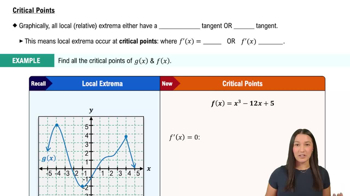
Critical Points

Critical points of a function occur where its derivative is either zero or undefined. These points are essential for identifying local maxima, minima, and points of inflection. To find critical points, one must first compute the derivative of the function and then solve for the values of x that satisfy the condition of the derivative being zero or undefined.
Recommended video:
04:50
Critical Points

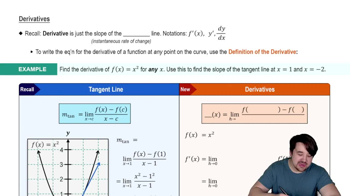
Derivative

The derivative of a function measures the rate at which the function's value changes as its input changes. It is a fundamental concept in calculus that provides information about the function's slope at any given point. For the function ƒ(x) = 1/x + ln x, the derivative must be calculated to locate the critical points, which involves applying the rules of differentiation.
Recommended video:
05:44
Derivatives

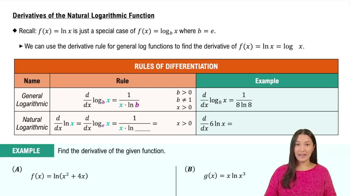
Natural Logarithm

The natural logarithm, denoted as ln(x), is the logarithm to the base e, where e is approximately 2.71828. It is a key function in calculus, particularly in integration and differentiation. In the context of the given function, understanding the properties of the natural logarithm is crucial for correctly differentiating and analyzing the function's behavior near its critical points.
Recommended video:
05:18
Derivative of the Natural Logarithmic Function
Related Practice
Textbook Question

{Use of Tech} Fixed points An important question about many functions concerns the existence and location of fixed points. A fixed point of f is a value of x that satisfies the equation f(x) = x; it corresponds to a point at which the graph of f intersects the line y = x. Find all the fixed points of the following functions. Use preliminary analysis and graphing to determine good initial approximations.


f(x) = tan x/2 on (-π,π)

Textbook Question

Increasing and decreasing functions. Find the intervals on which f is increasing and the intervals on which it is decreasing.


f(x) = x² - 2 ln x

Textbook Question

Locating critical points Find the critical points of the following functions. Assume a is a nonzero constant.


ƒ(x) = x √(x-a)

Textbook Question

17–83. Limits Evaluate the following limits. Use l’Hôpital’s Rule when it is convenient and applicable.


lim_x→ 0 (3 sin 4x) / 5x

Textbook Question

Use the following graphs to identify the points (if any) on the interval [a, b] at which the function has an absolute maximum or an absolute minimum value <IMAGE>

Textbook Question

{Use of Tech} Fixed points An important question about many functions concerns the existence and location of fixed points. A fixed point of f is a value of x that satisfies the equation f(x) = x; it corresponds to a point at which the graph of f intersects the line y = x. Find all the fixed points of the following functions. Use preliminary analysis and graphing to determine good initial approximations.


f(x) = x³ - 3x² + x + 1