Ch. 4 - Applications of the Derivative
Briggs - Calculus: Early Transcendentals 3rd Edition
Briggs3rd EditionCalculus: Early TranscendentalsISBN: 9780136847243Not the one you use?Change textbook
Chapter 4, Problem 4.9.5

Give the antiderivatives of xᵖ . For what values of p does your answer apply?

Verified step by step guidance
1
Step 1: Recall the general formula for the antiderivative of a power function xᵖ. The antiderivative of xᵖ is given by: ∫xᵖ dx = (1/(p+1)) * x^(p+1) + C, where C is the constant of integration.
Step 2: Identify the condition under which this formula is valid. The formula applies when p ≠ -1, because dividing by (p+1) would result in division by zero if p = -1.
Step 3: For the special case where p = -1, the antiderivative of x⁻¹ is ∫x⁻¹ dx = ∫(1/x) dx = ln|x| + C. This is derived from the natural logarithm function.
Step 4: Summarize the result. The antiderivative of xᵖ is (1/(p+1)) * x^(p+1) + C for p ≠ -1, and ln|x| + C for p = -1.
Step 5: Ensure clarity by emphasizing that the constant of integration, C, must always be included in the final expression for the antiderivative.

Verified video answer for a similar problem:

This video solution was recommended by our tutors as helpful for the problem above.
Video duration:
4m
Was this helpful?

Key Concepts

Here are the essential concepts you must grasp in order to answer the question correctly.

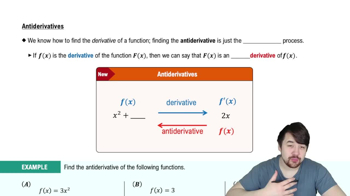
Antiderivative

An antiderivative of a function is another function whose derivative is the original function. In calculus, finding the antiderivative is a fundamental operation, often referred to as integration. For example, the antiderivative of x^p is (x^(p+1))/(p+1), provided p is not equal to -1.
Recommended video:
05:50
Antiderivatives

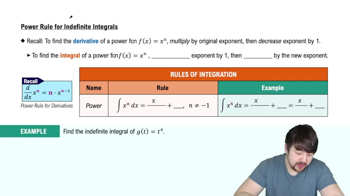
Power Rule for Integration

The Power Rule for Integration states that the integral of x raised to a power p is given by (x^(p+1))/(p+1) + C, where C is the constant of integration. This rule applies when p is not equal to -1, as the case p = -1 leads to the natural logarithm function, ln|x|, instead.
Recommended video:
04:04
Power Rule for Indefinite Integrals

Domain of the Antiderivative

The domain of the antiderivative refers to the values of p for which the antiderivative formula is valid. Specifically, the formula (x^(p+1))/(p+1) applies for all real numbers p except p = -1, where the function x^p becomes x^(-1) and its antiderivative is ln|x|, indicating a different behavior at that point.
Recommended video:
05:50
Antiderivatives