Ch. 4 - Applications of the Derivative
Briggs - Calculus: Early Transcendentals 3rd Edition
Briggs3rd EditionCalculus: Early TranscendentalsISBN: 9780136847243Not the one you use?Change textbook
Chapter 4, Problem 4.9.21

Finding antiderivatives. Find all the antiderivatives of the following functions. Check your work by taking derivatives.


g(s) = 1 / (s² + 1)

Verified step by step guidance
1
Step 1: Recognize that the function g(s) = 1 / (s² + 1) resembles the derivative of the arctangent function. Recall the formula for the derivative of arctan(x): d/dx [arctan(x)] = 1 / (x² + 1).
Step 2: Use the antiderivative rule to conclude that the integral of g(s) = 1 / (s² + 1) is arctan(s) + C, where C is the constant of integration.
Step 3: Write the general form of the antiderivative: G(s) = arctan(s) + C.
Step 4: To verify your work, take the derivative of G(s). Using the derivative rule for arctan(s), d/ds [arctan(s)] = 1 / (s² + 1), and the derivative of a constant is 0.
Step 5: Confirm that the derivative of G(s) matches the original function g(s). Since d/ds [arctan(s) + C] = 1 / (s² + 1), the solution is correct.

Verified video answer for a similar problem:

This video solution was recommended by our tutors as helpful for the problem above.
Video duration:
2m
Was this helpful?

Key Concepts

Here are the essential concepts you must grasp in order to answer the question correctly.

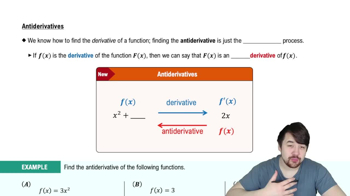
Antiderivatives

An antiderivative of a function is another function whose derivative is the original function. In calculus, finding antiderivatives is essential for solving problems related to integration. The process often involves recognizing patterns or applying integration techniques, such as substitution or integration by parts.
Recommended video:
05:50
Antiderivatives

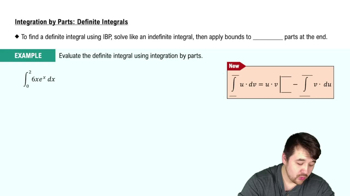
Integration Techniques

Integration techniques are methods used to find antiderivatives of functions that may not be straightforward. Common techniques include substitution, integration by parts, and partial fraction decomposition. Understanding these methods is crucial for effectively solving integrals, especially for more complex functions.
Recommended video:
06:18
Integration by Parts for Definite Integrals

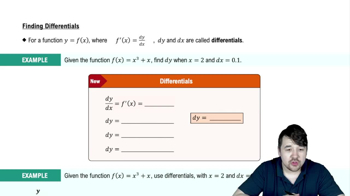
Verification by Differentiation

Verification by differentiation involves taking the derivative of the antiderivative found to ensure it matches the original function. This step is important for confirming the correctness of the antiderivative. It reinforces the fundamental theorem of calculus, which connects differentiation and integration.
Recommended video:
05:53
Finding Differentials