
Ch. 4 - Applications of the Derivative
Briggs - Calculus: Early Transcendentals 3rd Edition
Briggs3rd EditionCalculus: Early TranscendentalsISBN: 9780136847243Not the one you use?Change textbook
Chapter 4, Problem 4.9.13

Finding antiderivatives. Find all the antiderivatives of the following functions. Check your work by taking derivatives.


ƒ(x) = 2 sinx + 1

Verified step by step guidance
1
Step 1: Recall the definition of an antiderivative. The antiderivative of a function ƒ(x) is a function F(x) such that F'(x) = ƒ(x). For this problem, we are tasked with finding the antiderivative of ƒ(x) = 2 sin(x) + 1.
Step 2: Break the function ƒ(x) into its components. The function ƒ(x) = 2 sin(x) + 1 can be treated as the sum of two terms: 2 sin(x) and 1. Use the property of antiderivatives that states the antiderivative of a sum is the sum of the antiderivatives of the individual terms.
Step 3: Find the antiderivative of the first term, 2 sin(x). The antiderivative of sin(x) is -cos(x). Therefore, the antiderivative of 2 sin(x) is -2 cos(x).
Step 4: Find the antiderivative of the second term, 1. The antiderivative of a constant c is cx, so the antiderivative of 1 is x.
Step 5: Combine the results from Steps 3 and 4, and add the constant of integration C. The general antiderivative of ƒ(x) = 2 sin(x) + 1 is F(x) = -2 cos(x) + x + C. To verify, take the derivative of F(x) and confirm that it equals ƒ(x).

Verified video answer for a similar problem:

This video solution was recommended by our tutors as helpful for the problem above.
Video duration:
3m
Was this helpful?

Key Concepts

Here are the essential concepts you must grasp in order to answer the question correctly.

Antiderivative

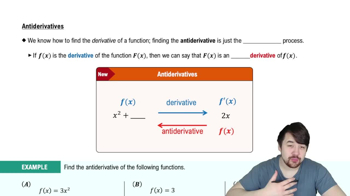
An antiderivative of a function is another function whose derivative is the original function. In calculus, finding antiderivatives is essential for solving problems related to integration. The general form of an antiderivative includes a constant of integration, C, since the derivative of a constant is zero, leading to multiple valid antiderivatives.
Recommended video:
05:50
Antiderivatives

Basic Integration Rules

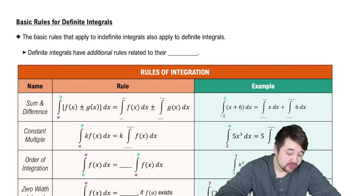
Basic integration rules are fundamental techniques used to find antiderivatives. For example, the integral of sin(x) is -cos(x), and the integral of a constant is the constant multiplied by x. Understanding these rules allows for the efficient computation of antiderivatives for various functions, including polynomials, trigonometric, and exponential functions.
Recommended video:
06:07
Basic Rules for Definite Integrals

Verification by Differentiation

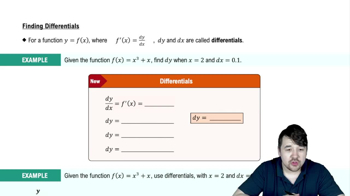
Verification by differentiation involves taking the derivative of the antiderivative found to ensure it matches the original function. This step is crucial for confirming the correctness of the antiderivative. If the derivative of the antiderivative equals the original function, it validates the solution and reinforces the relationship between differentiation and integration.
Recommended video:
05:53
Finding Differentials