Ch. 4 - Applications of the Derivative
Briggs - Calculus: Early Transcendentals 3rd Edition
Briggs3rd EditionCalculus: Early TranscendentalsISBN: 9780136847243Not the one you use?Change textbook
Chapter 4, Problem 4.R.12

Find the critical points of the following functions on the given intervals. Identify the absolute maximum and absolute minimum values (if they exist).
ƒ(x) = sin 2x + 3 on [-π , π]

Verified step by step guidance
1
To find the critical points of the function ƒ(x) = sin(2x) + 3 on the interval [-π, π], first compute the derivative of the function. The derivative of sin(2x) is 2cos(2x), so the derivative of ƒ(x) is ƒ'(x) = 2cos(2x).
Set the derivative ƒ'(x) = 2cos(2x) equal to zero to find the critical points. Solve the equation 2cos(2x) = 0, which simplifies to cos(2x) = 0.
The solutions to cos(2x) = 0 are 2x = π/2 + kπ, where k is an integer. Solve for x to find x = π/4 + kπ/2.
Determine which solutions for x fall within the interval [-π, π]. Substitute k = -2, -1, 0, 1, 2 into x = π/4 + kπ/2 to find the valid critical points within the interval.
Evaluate the function ƒ(x) = sin(2x) + 3 at the critical points and at the endpoints x = -π and x = π to determine the absolute maximum and minimum values. Compare these values to identify the absolute extrema.

Verified video answer for a similar problem:

This video solution was recommended by our tutors as helpful for the problem above.
Video duration:
9m
Was this helpful?

Key Concepts

Here are the essential concepts you must grasp in order to answer the question correctly.

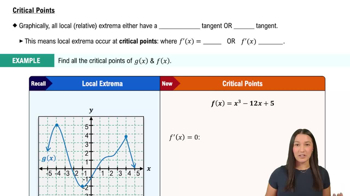
Critical Points

Critical points of a function occur where its derivative is zero or undefined. These points are essential for identifying local maxima and minima, as they represent potential locations where the function's behavior changes. To find critical points, one must first compute the derivative of the function and solve for the values of x that satisfy the condition.
Recommended video:
04:50
Critical Points

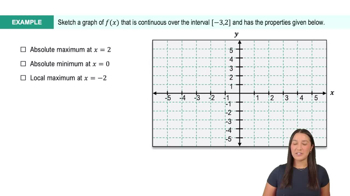
Absolute Maximum and Minimum

The absolute maximum and minimum values of a function on a closed interval are the highest and lowest values the function attains within that interval. To determine these values, one must evaluate the function at its critical points and at the endpoints of the interval. The largest and smallest of these values will be the absolute maximum and minimum, respectively.
Recommended video:
03:22
Finding Extrema Graphically Example 4

Interval Notation

Interval notation is a mathematical notation used to represent a range of values. In this context, the interval [-π, π] indicates that the function is being analyzed from -π to π, including both endpoints. Understanding interval notation is crucial for correctly identifying where to evaluate the function and its critical points.
Recommended video:
04:22
Sigma Notation