Ch. 4 - Applications of the Derivative
Briggs - Calculus: Early Transcendentals 3rd Edition
Briggs3rd EditionCalculus: Early TranscendentalsISBN: 9780136847243Not the one you use?Change textbook
Chapter 4, Problem 121b

Exponential growth rates
b. Compare the growth rates of eˣ and eᵃˣ as x→∞ , for a > 0.

Verified step by step guidance
1
To compare the growth rates of \( e^x \) and \( e^{ax} \) as \( x \to \infty \), we first need to understand the behavior of exponential functions. Both functions are exponential, but they have different exponents.
Consider the function \( e^x \). As \( x \to \infty \), \( e^x \) grows exponentially without bound. The base \( e \) is a constant greater than 1, which means the function increases rapidly.
Now, consider the function \( e^{ax} \). Here, \( a \) is a positive constant greater than 0. The exponent \( ax \) means that the rate of growth is scaled by \( a \). If \( a > 1 \), \( e^{ax} \) grows faster than \( e^x \). If \( 0 < a < 1 \), \( e^{ax} \) grows slower than \( e^x \).
To compare the growth rates more formally, we can take the limit of the ratio of the two functions as \( x \to \infty \): \( \lim_{x \to \infty} \frac{e^{ax}}{e^x} = \lim_{x \to \infty} e^{(a-1)x} \).
Evaluate the limit: If \( a > 1 \), \( e^{(a-1)x} \to \infty \), indicating \( e^{ax} \) grows faster. If \( 0 < a < 1 \), \( e^{(a-1)x} \to 0 \), indicating \( e^x \) grows faster. If \( a = 1 \), the limit is 1, indicating both grow at the same rate.

Verified video answer for a similar problem:

This video solution was recommended by our tutors as helpful for the problem above.
Video duration:
1m

Key Concepts

Here are the essential concepts you must grasp in order to answer the question correctly.

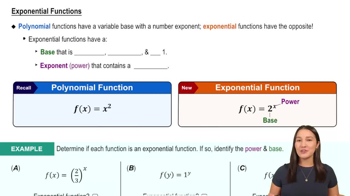
Exponential Functions

Exponential functions are mathematical expressions of the form f(x) = a * e^(bx), where 'e' is the base of the natural logarithm, approximately equal to 2.71828. These functions exhibit rapid growth or decay, depending on the sign of 'b'. Understanding their behavior as x approaches infinity is crucial for analyzing growth rates.
Recommended video:
6:13
Exponential Functions

Growth Rate Comparison

When comparing growth rates of functions, we often look at their limits as x approaches infinity. For the functions e^x and e^(ax) where a > 0, we can determine which function grows faster by evaluating the limit of their ratio. This comparison reveals that e^(ax) grows faster than e^x as x becomes very large.
Recommended video:
Guided course
04:16
Intro To Related Rates

Limit Analysis

Limit analysis is a fundamental concept in calculus that helps us understand the behavior of functions as they approach a certain point, often infinity. By applying limit techniques, we can rigorously determine the growth rates of functions like e^x and e^(ax) as x approaches infinity, providing insights into their relative rates of increase.
Recommended video:
05:50
One-Sided Limits