Ch. 4 - Applications of the Derivative
Briggs - Calculus: Early Transcendentals 3rd Edition
Briggs3rd EditionCalculus: Early TranscendentalsISBN: 9780136847243Not the one you use?Change textbook
Chapter 4, Problem 72b

Another pen problem A rancher is building a horse pen on the corner of her property using 1000 ft of fencing. Because of the unusual shape of her property, the pen must be built in the shape of a trapezoid (see figure). <IMAGE>
b. Suppose there is already a fence along the side of the property opposite the side of length y. Find the lengths of the sides that maximize the area of the pen, using 1000 ft of fencing.

Verified step by step guidance
1
Identify the variables: Let the lengths of the non-parallel sides of the trapezoid be x and z, and the length of the parallel side opposite to the existing fence be y.
Set up the constraint equation: Since the total amount of fencing available is 1000 ft, and one side is already fenced, the equation is x + y + z = 1000.
Express the area of the trapezoid: The area A of a trapezoid is given by A = (1/2) * (base1 + base2) * height. Here, base1 is y, base2 is the existing fence, and height can be expressed in terms of x and z using the Pythagorean theorem if needed.
Substitute the constraint into the area formula: Solve the constraint equation for one variable, say y = 1000 - x - z, and substitute this into the area formula to express A in terms of x and z.
Use calculus to find the maximum area: Take the partial derivatives of the area function with respect to x and z, set them to zero to find critical points, and use the second derivative test or analyze the critical points to determine which values of x and z maximize the area.

Verified video answer for a similar problem:

This video solution was recommended by our tutors as helpful for the problem above.
Video duration:
7m
Was this helpful?

Key Concepts

Here are the essential concepts you must grasp in order to answer the question correctly.

Optimization

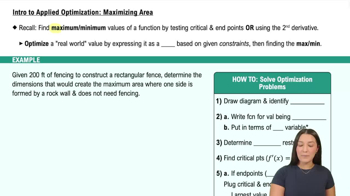
Optimization in calculus involves finding the maximum or minimum values of a function. In this context, the rancher needs to maximize the area of the trapezoidal pen while adhering to the constraint of 1000 ft of fencing. This typically involves setting up a function for the area in terms of the available dimensions and using techniques such as taking derivatives to find critical points.
Recommended video:
10:13
Intro to Applied Optimization: Maximizing Area

Area of a Trapezoid

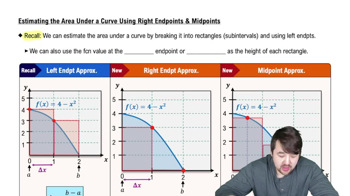
The area of a trapezoid can be calculated using the formula A = (1/2) * (b1 + b2) * h, where b1 and b2 are the lengths of the two parallel sides, and h is the height. Understanding this formula is crucial for determining how the dimensions of the pen relate to the total area, which the rancher aims to maximize while using the available fencing.
Recommended video:
05:59
Estimating the Area Under a Curve with Right Endpoints & Midpoint

Constraints in Optimization Problems

In optimization problems, constraints are conditions that must be satisfied while optimizing a function. In this scenario, the constraint is the total length of fencing available (1000 ft), which limits the dimensions of the trapezoid. Formulating the problem with these constraints allows for the application of methods such as the method of Lagrange multipliers or substitution to find the optimal solution.
Recommended video:
10:13
Intro to Applied Optimization: Maximizing Area