Ch. 4 - Applications of the Derivative
Briggs - Calculus: Early Transcendentals 3rd Edition
Briggs3rd EditionCalculus: Early TranscendentalsISBN: 9780136847243Not the one you use?Change textbook
Chapter 4, Problem 4.R.73

60–81. Limits Evaluate the following limits. Use l’Hôpital’s Rule when needed. 
lim_x→∞ ln ((x +1) / (x-1))

Verified step by step guidance
1
Identify the form of the limit as x approaches infinity: lim_(x→∞) ln((x + 1) / (x - 1)). This is an indeterminate form of type ∞/∞.
Apply l'Hôpital's Rule, which is used to evaluate limits of indeterminate forms. First, differentiate the numerator and the denominator of the argument of the logarithm separately.
Differentiate the numerator (x + 1) to get 1, and the denominator (x - 1) to get 1. The limit now becomes lim_(x→∞) ln(1).
Since ln(1) is a constant, the limit simplifies to 0.
Conclude that the limit of the original expression as x approaches infinity is 0.

Verified video answer for a similar problem:

This video solution was recommended by our tutors as helpful for the problem above.
Video duration:
2m
Was this helpful?

Key Concepts

Here are the essential concepts you must grasp in order to answer the question correctly.

Limits

Limits are fundamental concepts in calculus that describe the behavior of a function as its input approaches a certain value. They help in understanding the function's behavior at points where it may not be explicitly defined, such as at infinity or discontinuities. Evaluating limits is crucial for determining the continuity and differentiability of functions.
Recommended video:
05:50
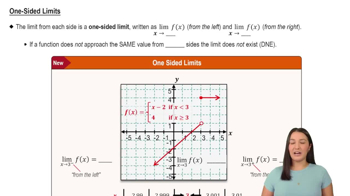
One-Sided Limits

Natural Logarithm

The natural logarithm, denoted as ln(x), is the logarithm to the base e, where e is approximately 2.71828. It is a key function in calculus, particularly in growth and decay problems, and is often used in limits involving exponential functions. Understanding its properties, such as its domain and range, is essential for evaluating limits that involve logarithmic expressions.
Recommended video:
05:18
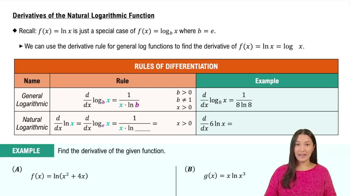
Derivative of the Natural Logarithmic Function

l'Hôpital's Rule

l'Hôpital's Rule is a method for evaluating limits that result in indeterminate forms, such as 0/0 or ∞/∞. It states that if the limit of f(x)/g(x) leads to an indeterminate form, the limit can be found by taking the derivative of the numerator and the derivative of the denominator separately. This rule simplifies the process of finding limits, especially when dealing with complex functions.
Recommended video:
Related Practice
Textbook Question

60–81. Limits Evaluate the following limits. Use l’Hôpital’s Rule when needed. 

lim_x→1 ( x- 1)^sinπx

1
views

Textbook Question

Locating extrema Consider the graph of a function ƒ on the interval [-3, 3]. <IMAGE>

b. Give the approximate coordinates of the absolute maximum and minimum values of ƒ (if they exist).

Textbook Question

Optimal popcorn box A small popcorn box is created from a 12" x 12" sheet of paperboard by first cutting out four shaded rectangles, each of length x and width x/2 (see figure). The remaining paperboard is folded along the solid lines to form a box. What dimensions of the box maximize the volume of the box? <IMAGE>

Textbook Question

Minimum painting surface A metal cistern in the shape of a right circular cylinder with volume V = 50 m³ needs to be painted each year to reduce corrosion. The paint is applied only to surfaces exposed to the elements (the outside cylinder wall and the circular top). Find the dimensions r and h of the cylinder that minimize the area of the painted surfaces.

Textbook Question

24–34. Curve sketching Use the guidelines given in Section 4.4 to make a complete graph of the following functions on their domains or on the given interval. Use a graphing utility to check your work.


ƒ(x) = 4cos (π (x-1)) on [0, 2]

Textbook Question

Find the critical points of the following functions on the given intervals. Identify the absolute maximum and absolute minimum values (if they exist).

g(x) = x⁴ - 50x² on [-1, 5]

1
views