
Ch. 4 - Applications of the Derivative
Briggs - Calculus: Early Transcendentals 3rd Edition
Briggs3rd EditionCalculus: Early TranscendentalsISBN: 9780136847243Not the one you use?Change textbook
Chapter 4, Problem 4.7.46

17–83. Limits Evaluate the following limits. Use l’Hôpital’s Rule when it is convenient and applicable.


lim_x→∞ (ln(3x + 5eˣ)) / (ln(7x + 3e²ˣ)

Verified step by step guidance
1
Identify the form of the limit as x approaches infinity. Both the numerator and the denominator are logarithmic functions, which tend to infinity as x approaches infinity. This suggests an indeterminate form of type ∞/∞, making l'Hôpital's Rule applicable.
Apply l'Hôpital's Rule, which states that for limits of the form ∞/∞, the limit of the ratio of the derivatives of the numerator and the denominator can be taken. Differentiate the numerator: d/dx[ln(3x + 5e^x)] = (3 + 5e^x) / (3x + 5e^x).
Differentiate the denominator: d/dx[ln(7x + 3e^(2x))] = (7 + 6xe^(2x)) / (7x + 3e^(2x)).
Substitute the derivatives back into the limit expression: lim_x→∞ [(3 + 5e^x) / (3x + 5e^x)] / [(7 + 6xe^(2x)) / (7x + 3e^(2x))].
Simplify the expression by dividing the numerators and denominators, and evaluate the limit as x approaches infinity. Consider the dominant terms in the expressions to determine the behavior of the limit.

Verified video answer for a similar problem:

This video solution was recommended by our tutors as helpful for the problem above.
Video duration:
8m
Was this helpful?

Key Concepts

Here are the essential concepts you must grasp in order to answer the question correctly.

Limits

Limits are fundamental concepts in calculus that describe the behavior of a function as its input approaches a certain value. They help in understanding the function's behavior at points where it may not be explicitly defined, such as at infinity or at points of discontinuity. Evaluating limits is crucial for determining the continuity and differentiability of functions.
Recommended video:
05:50
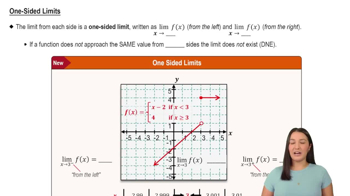
One-Sided Limits

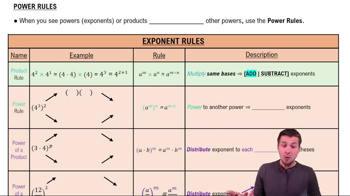
L'Hôpital's Rule

L'Hôpital's Rule is a method used to evaluate limits that result in indeterminate forms, such as 0/0 or ∞/∞. It states that if the limit of the ratio of two functions yields an indeterminate form, the limit of their derivatives can be taken instead. This rule simplifies the process of finding limits, especially when dealing with logarithmic or exponential functions.
Recommended video:

Natural Logarithm

The natural logarithm, denoted as ln(x), is the logarithm to the base e, where e is approximately 2.71828. It is a key function in calculus, particularly in growth and decay problems, and is often used in conjunction with limits and derivatives. Understanding the properties of logarithms, such as their behavior at infinity, is essential for evaluating limits involving logarithmic expressions.
Recommended video:
05:18
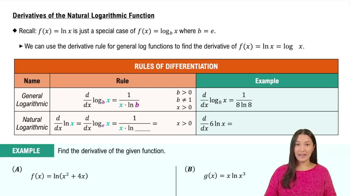
Derivative of the Natural Logarithmic Function
Related Practice
Textbook Question

{Use of Tech} Tumor size In a study conducted at Dartmouth College, mice with a particular type of cancerous tumor were treated with the chemotherapy drug Cisplatin. If the volume of one of these tumors at the time of treatment is V₀, then the volume of the tumor t days after treatment is modeled by the function V(t) = V₀ (0.99e⁻⁰·¹²¹⁶ᵗ + 0.01e⁰·²³⁹ᵗ). (Source: Undergraduate Mathematics for the Life Sciences, MAA Notes No. 81, 2013)


Plot a graph of y = 0.99e⁻⁰·¹²¹⁶ᵗ + 0.01e⁰·²³⁹ᵗ, for 0 ≤ t ≤ 16, and describe the tumor size over time. Use Newton’s method to determine when the tumor decreases to half of its original size.

Textbook Question

Differentials Consider the following functions and express the relationship between a small change in x and the corresponding change in y in the form dy = f'(x)dx.


f(x) = ln (1 - x)

Textbook Question

Velocity to position Given the following velocity functions of an object moving along a line, find the position function with the given initial position.


v(t) = 2t + 4; s(0) = 0

Textbook Question

23–68. Indefinite integrals Determine the following indefinite integrals. Check your work by differentiation.


∫ (eˣ⁺²) dx

Textbook Question

{Use of Tech} Fixed points An important question about many functions concerns the existence and location of fixed points. A fixed point of f is a value of x that satisfies the equation f(x) = x; it corresponds to a point at which the graph of f intersects the line y = x. Find all the fixed points of the following functions. Use preliminary analysis and graphing to determine good initial approximations.


f(x) = tan x/2 on (-π,π)

Textbook Question

Particular antiderivatives For the following functions f, find the antiderivative F that satisfies the given condition.


f(v) = sec v tan v; F(0) = 2, -π/2 < v < π/2