
Ch. 3 - Derivatives
Briggs - Calculus: Early Transcendentals 3rd Edition
Briggs3rd EditionCalculus: Early TranscendentalsISBN: 9780136847243Not the one you use?Change textbook
Chapter 3, Problem 3.8.44b

Volume of a torus The volume of a torus (doughnut or bagel) with an inner radius of a and an outer radius of b is V=π²(b+a)(b−a)²/4.
b. Evaluate this derivative when a=6 and b=10.

Verified step by step guidance
1
First, identify the formula for the volume of the torus: \( V = \frac{\pi^2 (b+a)(b-a)^2}{4} \).
To find the derivative of the volume with respect to the outer radius \( b \), apply the product rule and chain rule to the expression \( V = \frac{\pi^2}{4} (b+a)(b-a)^2 \).
Differentiate \( (b+a) \) with respect to \( b \), which is simply 1, since \( a \) is a constant.
Differentiate \( (b-a)^2 \) with respect to \( b \) using the chain rule: \( 2(b-a) \cdot 1 \).
Substitute \( a = 6 \) and \( b = 10 \) into the derivative expression to evaluate it at these values.

Verified video answer for a similar problem:

This video solution was recommended by our tutors as helpful for the problem above.
Video duration:
11m
Was this helpful?

Key Concepts

Here are the essential concepts you must grasp in order to answer the question correctly.

Volume of a Torus

The volume of a torus is calculated using the formula V=π²(b+a)(b−a)²/4, where 'a' is the inner radius and 'b' is the outer radius. This formula derives from integrating the area of circular cross-sections of the torus, taking into account the geometry of the shape. Understanding this formula is essential for evaluating the volume based on given radii.
Recommended video:
08:29
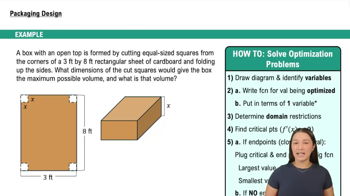
Example 5: Packaging Design

Derivative

A derivative represents the rate of change of a function with respect to a variable. In this context, evaluating the derivative of the volume function with respect to the radii 'a' and 'b' will provide insights into how changes in these dimensions affect the volume of the torus. Mastery of differentiation techniques is crucial for solving problems involving rates of change.
Recommended video:
05:44
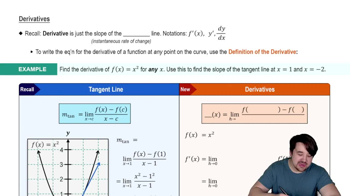
Derivatives

Evaluation of Functions

Evaluating a function involves substituting specific values into the function to compute a result. In this case, substituting a=6 and b=10 into the volume formula allows for the calculation of the torus's volume. This concept is fundamental in calculus, as it connects theoretical functions to practical numerical results.
Recommended video:
4:26
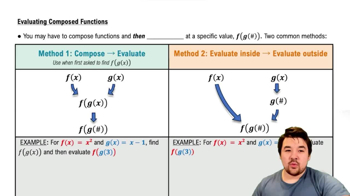
Evaluating Composed Functions
Related Practice
Textbook Question

Owlet talons Let L (t) equal the average length (in mm) of the middle talon on an Indian spotted owlet that is t weeks old, as shown in the figure.<IMAGE>

b. Estimate the value of L'(a) for a ≥ 4 . What does this tell you about the talon lengths on these birds? (Source: ZooKeys, 132, 2011)

1
views
Textbook Question

60–62. {Use of Tech} Multiple tangent lines Complete the following steps. <IMAGE>

b. Graph the tangent lines on the given graph.

x+y³−y=1; x=1

Textbook Question

{Use of Tech} A mixing tank A 500-liter (L) tank is filled with pure water. At time t=0, a salt solution begins flowing into the tank at a rate of 5 L/min. At the same time, the (fully mixed) solution flows out of the tank at a rate of 5.5 L/min. The mass of salt in grams in the tank at any time t≥0 is given by M(t) = 250(1000−t)(1−10−³⁰(1000−t)¹⁰) and the volume of solution in the tank is given by V(t) = 500-0.5t.

b. Graph the volume function and verify that the tank is empty when t=1000 min. 

Textbook Question

The Chain Rule for second derivatives

b. Use the formula in part (a) to calculate d2dx2(sin(3x4+5x2+2))\(\frac{d^2}{dx^2}\[\left\)(\(\sin\]\left\)(3x^4+5x^2+2\(\right\))\(\right\)).

Textbook Question

City urbanization City planners model the size of their city using the function A(t) = - 1/50t² + 2t +20, for 0 ≤ t ≤ 50, where A is measured in square miles and t is the number of years after 2010.

b. How fast will the city be growing when it reaches a size of 38 mi²?

1
views
Textbook Question

Derivatives and tangent lines

b. Determine an equation of the line tangent to the graph of f at the point (a,f(a)) for the given value of a.

f(x) = 1/3x-1; a= 2