Ch. 3 - Derivatives
Briggs - Calculus: Early Transcendentals 3rd Edition
Briggs3rd EditionCalculus: Early TranscendentalsISBN: 9780136847243Not the one you use?Change textbook
Chapter 3, Problem 3.2.73a

Vertical tangent lines If a function f is continuous at a and lim x→a| f′(x)|=∞, then the curve y=f(x) has a vertical tangent line at a, and the equation of the tangent line is x=a. If a is an endpoint of a domain, then the appropriate one-sided derivative (Exercises 71–72) is used. Use this information to answer the following questions.
73. {Use of Tech} Graph the following functions and determine the location of the vertical tangent lines.
a. f(x) = (x-2)^1/3

Verified step by step guidance
1
Step 1: Understand the problem statement. We need to determine where the function f(x) = (x-2)^{1/3} has vertical tangent lines by analyzing the behavior of its derivative.
Step 2: Find the derivative of the function f(x) = (x-2)^{1/3}. Use the power rule for derivatives, which states that if f(x) = x^n, then f'(x) = n*x^{n-1}.
Step 3: Apply the power rule to f(x) = (x-2)^{1/3}. The derivative f'(x) will be (1/3)*(x-2)^{-2/3}.
Step 4: Analyze the behavior of f'(x) as x approaches the point of interest, which is x = 2. Specifically, evaluate the limit lim_{x→2} |f'(x)| to determine if it approaches infinity.
Step 5: Conclude that if lim_{x→2} |f'(x)| = ∞, then there is a vertical tangent line at x = 2. The equation of this vertical tangent line is x = 2.

Verified video answer for a similar problem:

This video solution was recommended by our tutors as helpful for the problem above.
Video duration:
7m
Was this helpful?

Key Concepts

Here are the essential concepts you must grasp in order to answer the question correctly.

Vertical Tangent Lines

A vertical tangent line occurs at a point on a curve where the slope of the tangent approaches infinity. This typically indicates that the function is changing very rapidly at that point, leading to a vertical orientation of the tangent line. Mathematically, this is represented by the condition that the limit of the derivative approaches infinity as x approaches the point of tangency.
Recommended video:
05:13
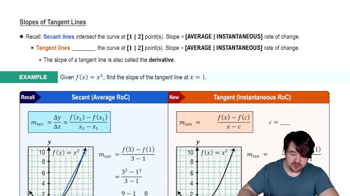
Slopes of Tangent Lines

Continuity and Derivatives

For a function to have a vertical tangent line at a point, it must be continuous at that point. Additionally, the behavior of the derivative is crucial; if the limit of the absolute value of the derivative approaches infinity as x approaches the point, it confirms the presence of a vertical tangent. This relationship between continuity and the behavior of derivatives is fundamental in calculus.
Recommended video:
05:34
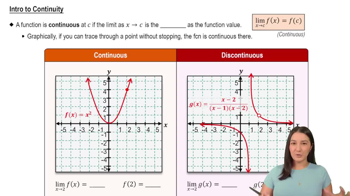
Intro to Continuity

One-Sided Derivatives

One-sided derivatives are used to analyze the behavior of a function at endpoints of its domain or at points where the function may not be differentiable in the traditional sense. The left-hand derivative and right-hand derivative provide insights into the slope of the function from either side of a point, which is essential for determining the nature of the tangent line at that point, especially in cases of vertical tangents.
Recommended video:
05:50
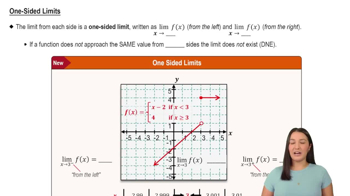
One-Sided Limits