Ch. 3 - Derivatives
Briggs - Calculus: Early Transcendentals 3rd Edition
Briggs3rd EditionCalculus: Early TranscendentalsISBN: 9780136847243Not the one you use?Change textbook
Chapter 3, Problem 3.5.19

Use Theorem 3.10 to evaluate the following limits.
lim x🠂2 (sin (x-2)) / (x2 - 4)

Verified step by step guidance
1
Theorem 3.10 refers to L'Hôpital's Rule, which is used to evaluate limits of indeterminate forms like 0/0 or ∞/∞. First, check if the given limit is in an indeterminate form by substituting x = 2 into the expression.
Substitute x = 2 into the expression: (sin(x-2)) / (x^2 - 4). This results in (sin(0)) / (2^2 - 4), which simplifies to 0/0, confirming the indeterminate form.
Since the limit is in the 0/0 indeterminate form, apply L'Hôpital's Rule. This involves taking the derivative of the numerator and the derivative of the denominator separately.
Differentiate the numerator: The derivative of sin(x-2) with respect to x is cos(x-2). Differentiate the denominator: The derivative of x^2 - 4 with respect to x is 2x.
Apply L'Hôpital's Rule by taking the limit of the new expression: lim x→2 (cos(x-2)) / (2x). Substitute x = 2 into this expression to evaluate the limit.

Verified video answer for a similar problem:

This video solution was recommended by our tutors as helpful for the problem above.
Video duration:
3m
Was this helpful?

Key Concepts

Here are the essential concepts you must grasp in order to answer the question correctly.

Limits

Limits are fundamental in calculus, representing the value that a function approaches as the input approaches a certain point. In this context, evaluating the limit as x approaches 2 involves determining the behavior of the function (sin(x-2) / (x² - 4)) near that point, which may require simplification or application of limit laws.
Recommended video:
05:50
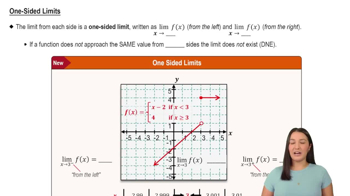
One-Sided Limits

Theorem 3.10 (L'Hôpital's Rule)

Theorem 3.10, commonly known as L'Hôpital's Rule, provides a method for evaluating limits that result in indeterminate forms like 0/0 or ∞/∞. It states that if such a form occurs, the limit of the ratio of two functions can be found by taking the derivative of the numerator and the derivative of the denominator, and then re-evaluating the limit.
Recommended video:
06:11
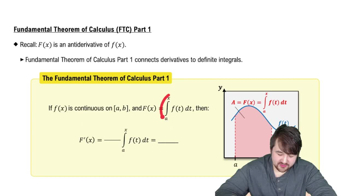
Fundamental Theorem of Calculus Part 1

Trigonometric Limits

Trigonometric limits often involve functions like sine and cosine, which can exhibit unique behaviors near certain points. In this case, the limit of sin(x-2) as x approaches 2 is crucial, as it simplifies the evaluation of the overall limit. Understanding the properties of trigonometric functions helps in resolving limits involving these functions effectively.
Recommended video:
6:04
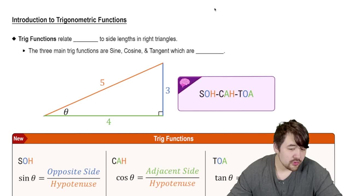
Introduction to Trigonometric Functions