Ch. 3 - Derivatives
Briggs - Calculus: Early Transcendentals 3rd Edition
Briggs3rd EditionCalculus: Early TranscendentalsISBN: 9780136847243Not the one you use?Change textbook
Chapter 3, Problem 3.R.96b

{Use of Tech} Beak length The length of the culmen (the upper ridge of a bird’s bill) of a t-week-old Indian spotted owlet is modeled by the function L(t)=11.94 / 1 + 4e^−1.65t, where L is measured in millimeters.
b. Use a graph of L′(t) to describe how the culmen grows over the first 5 weeks of life.

Verified step by step guidance
1
First, understand that L(t) is a function that models the length of the culmen of an owlet over time. The function is given as L(t) = \(\frac{11.94}{1 + 4e^{-1.65t}}\). Our task is to analyze the growth rate of the culmen by examining the derivative L'(t).
To find L'(t), we need to differentiate L(t) with respect to t. This involves using the quotient rule for differentiation, which is given by \(\frac{d}{dt}\left(\frac{u}{v}\right) = \frac{v \cdot u' - u \cdot v'}{v^2}\), where u = 11.94 and v = 1 + 4e^{-1.65t}.
Calculate the derivatives u' and v'. Since u is a constant, u' = 0. For v, use the chain rule to find v' = \(-4 \cdot (-1.65) \cdot e^{-1.65t}\). Simplify this to v' = 6.6e^{-1.65t}.
Substitute u, u', v, and v' into the quotient rule formula to find L'(t). This will give you the expression for the rate of change of the culmen length with respect to time.
Finally, use a graphing tool to plot L'(t) over the interval from t = 0 to t = 5. Analyze the graph to describe how the growth rate of the culmen changes over the first 5 weeks. Look for trends such as increasing, decreasing, or constant growth rates.

Verified video answer for a similar problem:

This video solution was recommended by our tutors as helpful for the problem above.
Video duration:
5m
Was this helpful?

Key Concepts

Here are the essential concepts you must grasp in order to answer the question correctly.

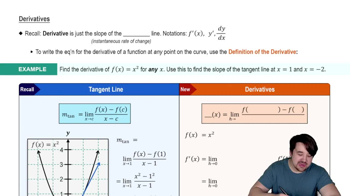
Derivative

The derivative of a function measures the rate at which the function's value changes as its input changes. In this context, L'(t) represents the growth rate of the culmen length over time, indicating how quickly the length is increasing or decreasing at any given moment.
Recommended video:
05:44
Derivatives

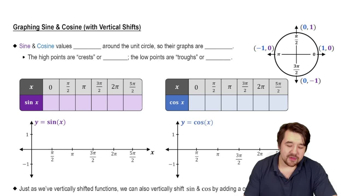
Graphing Functions

Graphing functions involves plotting the values of a function on a coordinate system to visualize its behavior. For L'(t), the graph will show how the growth rate of the culmen changes over the first five weeks, helping to identify periods of rapid growth or stagnation.
Recommended video:
5:53
Graph of Sine and Cosine Function

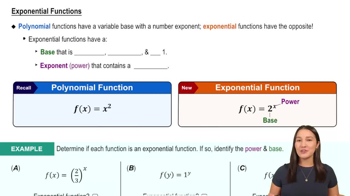
Exponential Functions

Exponential functions are characterized by a constant base raised to a variable exponent, often representing growth or decay processes. The function L(t) includes an exponential term, which influences the growth pattern of the culmen length, particularly in the early stages of the owlet's life.
Recommended video:
6:13
Exponential Functions