Ch. 3 - Derivatives
Briggs - Calculus: Early Transcendentals 3rd Edition
Briggs3rd EditionCalculus: Early TranscendentalsISBN: 9780136847243Not the one you use?Change textbook
Chapter 3, Problem 51a

{Use of Tech} A different interpretation of marginal cost Suppose a large company makes 25,000 gadgets per year in batches of x items at a time. After analyzing setup costs to produce each batch and taking into account storage costs, planners have determined that the total cost C(x) of producing 25,000 gadgets in batches of x items at a time is given by C(x) = 1,250,000+125,000,000 / x + 1.5x.
a. Determine the marginal cost and average cost functions. Graph and interpret these functions.

Verified step by step guidance
1
First, let's understand the concept of marginal cost. Marginal cost is the derivative of the total cost function C(x) with respect to x. It represents the rate of change of the total cost as the number of items per batch changes.
To find the marginal cost function, differentiate the given total cost function C(x) = 1,250,000 + 125,000,000 / x + 1.5x with respect to x. Use the power rule and the derivative of 1/x, which is -1/x^2.
Next, let's determine the average cost function. The average cost function is the total cost C(x) divided by the number of items produced, which is 25,000. So, the average cost function A(x) is A(x) = C(x) / 25,000.
To graph these functions, plot the marginal cost function and the average cost function on the same set of axes. The x-axis represents the number of items per batch, and the y-axis represents the cost. Analyze how the marginal cost changes as x increases and how the average cost behaves.
Interpret the graphs: The marginal cost graph shows how the cost changes with each additional item per batch. If the marginal cost is decreasing, it indicates economies of scale. The average cost graph helps understand the cost per item produced, which is useful for pricing and production decisions.

Verified video answer for a similar problem:

This video solution was recommended by our tutors as helpful for the problem above.
Video duration:
6m
Was this helpful?

Key Concepts

Here are the essential concepts you must grasp in order to answer the question correctly.

Marginal Cost

Marginal cost refers to the additional cost incurred when producing one more unit of a good or service. It is calculated as the derivative of the total cost function with respect to the quantity produced. In this context, understanding how to derive the marginal cost function from the given total cost function C(x) is essential for analyzing production efficiency and cost management.
Recommended video:
07:32
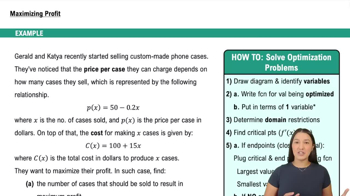
Example 3: Maximizing Profit

Average Cost

Average cost is the total cost of production divided by the number of units produced. It provides insight into the cost per unit when producing a certain quantity. To find the average cost function from the total cost function C(x), one would divide C(x) by the number of units produced, which in this case is 25,000 divided by x. This concept helps in evaluating the overall cost efficiency of production.
Recommended video:
06:37
Average Value of a Function

Graphing Functions

Graphing functions involves plotting the marginal and average cost functions on a coordinate system to visually analyze their behavior. This graphical representation helps in identifying key features such as intersections, trends, and asymptotic behavior, which are crucial for interpreting the economic implications of production costs. Understanding how to graph these functions will aid in making informed decisions regarding production levels.
Recommended video:
5:53
Graph of Sine and Cosine Function