Ch. 3 - Derivatives
Briggs - Calculus: Early Transcendentals 3rd Edition
Briggs3rd EditionCalculus: Early TranscendentalsISBN: 9780136847243Not the one you use?Change textbook
Chapter 3, Problem 3.11.56

Two boats leave a port at the same time, one traveling west at 20 mi/hr and the other traveling southwest ( 45° south of west) at 15 mi/hr. After 30 minutes, how far apart are the boats and at what rate is the distance between them changing? (Hint: Use the Law of Cosines.)

Verified step by step guidance
1
First, determine the distance each boat has traveled after 30 minutes. Since 30 minutes is 0.5 hours, the westbound boat travels 20 mi/hr * 0.5 hr = 10 miles, and the southwest-bound boat travels 15 mi/hr * 0.5 hr = 7.5 miles.
Next, set up a triangle where the two boats are at the ends of two sides, and the angle between their paths is 45°. The westbound boat's path is one side, and the southwest-bound boat's path is the other side.
Use the Law of Cosines to find the distance between the two boats. The Law of Cosines states: c^2 = a^2 + b^2 - 2ab * cos(C), where a and b are the sides of the triangle, and C is the angle between them. Here, a = 10 miles, b = 7.5 miles, and C = 45°.
Substitute the known values into the Law of Cosines: c^2 = 10^2 + 7.5^2 - 2 * 10 * 7.5 * cos(45°). Calculate the cosine of 45°, which is √2/2, and substitute it into the equation.
Finally, to find the rate at which the distance between the boats is changing, differentiate the Law of Cosines equation with respect to time. This involves using implicit differentiation and considering the rates of change of the distances traveled by each boat.

Verified video answer for a similar problem:

This video solution was recommended by our tutors as helpful for the problem above.
Video duration:
9m
Was this helpful?

Key Concepts

Here are the essential concepts you must grasp in order to answer the question correctly.

Law of Cosines

The Law of Cosines is a formula used in geometry to find the lengths of sides in a triangle when two sides and the included angle are known. It states that for any triangle with sides a, b, and c, and angle C opposite side c, the relationship is c² = a² + b² - 2ab * cos(C). This law is particularly useful in this problem to determine the distance between the two boats after they have traveled for a certain time.
Recommended video:
4:49
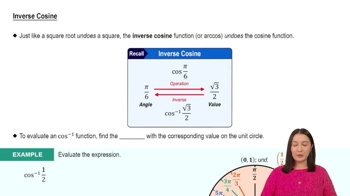
Inverse Cosine

Relative Velocity

Relative velocity refers to the velocity of one object as observed from another object. In this scenario, understanding how the velocities of the two boats interact is crucial for determining how quickly the distance between them is changing. By analyzing their velocities in terms of components, we can calculate the rate at which the distance between the boats increases.
Recommended video:
06:29
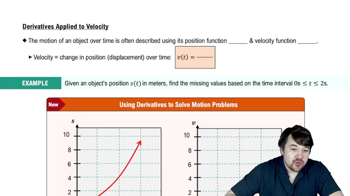
Derivatives Applied To Velocity

Trigonometric Functions

Trigonometric functions, such as sine, cosine, and tangent, relate the angles and sides of triangles. In this problem, the angle at which the second boat travels (southwest) is essential for breaking down its velocity into components. These functions will help in calculating the positions of the boats and ultimately in applying the Law of Cosines to find the distance between them.
Recommended video:
6:04
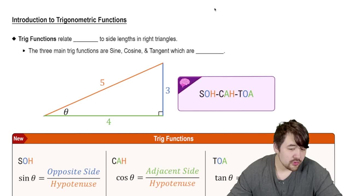
Introduction to Trigonometric Functions