Ch. 3 - Derivatives
Briggs - Calculus: Early Transcendentals 3rd Edition
Briggs3rd EditionCalculus: Early TranscendentalsISBN: 9780136847243Not the one you use?Change textbook
Chapter 3, Problem 3.11.47

The bottom of a large theater screen is 3 ft above your eye level and the top of the screen is 10 ft above your eye level. Assume you walk away from the screen (perpendicular to the screen) at a rate of 3 ft/s while looking at the screen. What is the rate of change of the viewing angle θ when you are 30 ft from the wall on which the screen hangs, assuming the floor is horizontal (see figure)? <IMAGE>

Verified step by step guidance
1
First, understand the setup: You have a right triangle where the horizontal distance from the screen is the base, and the height of the screen forms the vertical side. The angle θ is the angle of elevation from your eye level to the top of the screen.
Define the variables: Let x be the distance from the screen, which changes over time. The height of the screen above your eye level is constant at 10 ft - 3 ft = 7 ft.
Use trigonometry to relate the angle θ to the distance x. The tangent of the angle θ is given by the ratio of the opposite side (height of the screen) to the adjacent side (distance from the screen): tan(θ) = 7/x.
Differentiate the equation tan(θ) = 7/x with respect to time t to find the rate of change of θ. Use implicit differentiation: d/dt [tan(θ)] = d/dt [7/x].
Apply the chain rule: sec²(θ) * (dθ/dt) = -7/x² * (dx/dt). Substitute dx/dt = 3 ft/s and x = 30 ft into the equation to solve for dθ/dt, the rate of change of the viewing angle.

Verified video answer for a similar problem:

This video solution was recommended by our tutors as helpful for the problem above.
Video duration:
10m
Was this helpful?

Key Concepts

Here are the essential concepts you must grasp in order to answer the question correctly.

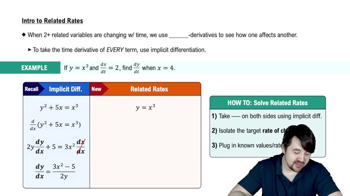
Related Rates

Related rates involve finding the rate at which one quantity changes in relation to another. In this problem, the viewing angle θ changes as the distance from the screen increases. By applying the concept of related rates, we can use derivatives to relate the rates of change of the distance from the screen and the angle of view.
Recommended video:
04:16
Intro To Related Rates

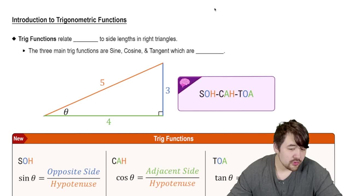
Trigonometric Functions

Trigonometric functions, particularly tangent, are essential for relating angles to opposite and adjacent sides in right triangles. In this scenario, the height of the screen and the distance from the viewer to the screen form a right triangle, allowing us to express the angle θ in terms of these dimensions using the tangent function.
Recommended video:
6:04
Introduction to Trigonometric Functions

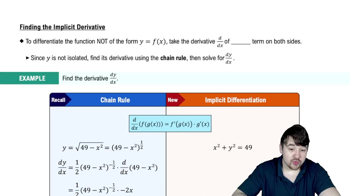
Implicit Differentiation

Implicit differentiation is a technique used to differentiate equations that define one variable in terms of another without explicitly solving for one variable. In this problem, we can differentiate the relationship between the angle θ and the distance from the screen to find the rate of change of θ with respect to time, which is crucial for solving the problem.
Recommended video:
05:14
Finding The Implicit Derivative