
Ch. 3 - Derivatives
Briggs - Calculus: Early Transcendentals 3rd Edition
Briggs3rd EditionCalculus: Early TranscendentalsISBN: 9780136847243Not the one you use?Change textbook
Chapter 3, Problem 17e

Suppose the position of an object moving horizontally along a line after t seconds is given by the following functions s = f(t), where s is measured in feet, with s > 0 corresponding to positions right of the origin.
On what intervals is the speed increasing?
f(t) = 2t2 - 9t + 12; 0 ≤ t ≤ 3

Verified step by step guidance
1
Step 1: Understand that speed is the absolute value of velocity. To find when speed is increasing, we need to determine when the derivative of the speed function is positive.
Step 2: Find the velocity function by taking the derivative of the position function f(t). The velocity v(t) is given by v(t) = f'(t) = \(\frac{d}{dt}\)(2t^2 - 9t + 12).
Step 3: Calculate the derivative: f'(t) = 4t - 9. This is the velocity function v(t).
Step 4: Determine when the velocity is increasing by finding the derivative of the velocity function, which is the acceleration a(t). So, a(t) = v'(t) = \(\frac{d}{dt}\)(4t - 9).
Step 5: Calculate the acceleration: a(t) = 4. Since the acceleration is constant and positive, the velocity is increasing for all t in the interval 0 ≤ t ≤ 3. Therefore, the speed is increasing wherever the velocity is positive.

Verified video answer for a similar problem:

This video solution was recommended by our tutors as helpful for the problem above.
Video duration:
5m
Was this helpful?

Key Concepts

Here are the essential concepts you must grasp in order to answer the question correctly.

Position Function

The position function, denoted as s = f(t), describes the location of an object at any given time t. In this case, f(t) = 2t² - 9t + 12 represents a quadratic function, which can be analyzed to determine the object's position over time. Understanding the shape and properties of this function is crucial for determining intervals of motion.
Recommended video:
5:20
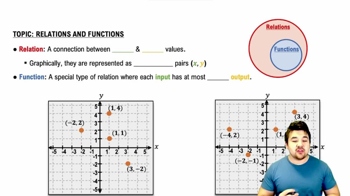
Relations and Functions

Velocity and Speed

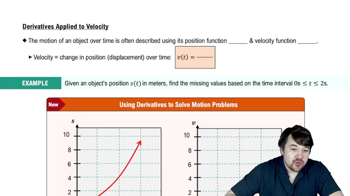
Velocity is the derivative of the position function, f'(t), and indicates the rate of change of position with respect to time. Speed, being the absolute value of velocity, reflects how fast the object is moving regardless of direction. To find when speed is increasing, one must analyze the sign of the derivative of the velocity function.
Recommended video:
06:29
Derivatives Applied To Velocity

Increasing Functions

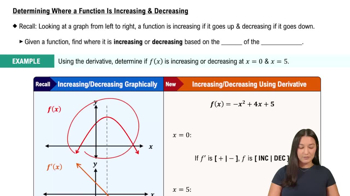
A function is said to be increasing on an interval if its derivative is positive throughout that interval. For the speed of the object to be increasing, the derivative of the velocity function must also be positive. This requires finding the second derivative of the position function and determining where it is greater than zero.
Recommended video:
07:32
Determining Where a Function is Increasing & Decreasing