
Textbook Question
Use definition (1) (p. 133) to find the slope of the line tangent to the graph of f at P.
f(x) = √(3x + 3); P(2,3)

 Verified step by step guidance
 5:20
5:20
 06:29
06:29 06:15
06:15Use definition (1) (p. 133) to find the slope of the line tangent to the graph of f at P.
f(x) = √(3x + 3); P(2,3)
5–24. For each of the following composite functions, find an inner function u=g(x) and an outer function y=f(u) such that y=f(g(x)). Then calculate dy/dx.
y = √x²+1
Use definition (1) (p. 133) to find the slope of the line tangent to the graph of f at P.
f(x) = 4/x2; P(-1,4)
5–24. For each of the following composite functions, find an inner function u=g(x) and an outer function y=f(u) such that y=f(g(x)). Then calculate dy/dx.
y = sin x⁵
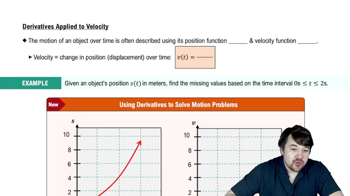
Suppose the position of an object moving horizontally along a line after t seconds is given by the following functions s = f(t), where s is measured in feet, with s > 0 corresponding to positions right of the origin.
Determine the velocity and acceleration of the object at t = 1.
f(t) = 2t3 - 21t2 + 60t; 0 ≤ t ≤ 6
Position, velocity, and acceleration Suppose the position of an object moving horizontally along a line after t seconds is given by the following functions s = f(t), where s is measured in feet, with s > 0 corresponding to positions right of the origin.
b. Find and graph the velocity function. When is the object stationary, moving to the right, and moving to the left?
f(t) = 18t-3t²; 0 ≤ t ≤ 8