Find d/dx (In(xe^x)) without using the Chain Rule and the Product Rule.
Ch. 3 - Derivatives
Briggs3rd EditionCalculus: Early TranscendentalsISBN: 9780136847243Not the one you use?Change textbook
Chapter 3, Problem 3.6.39
Matching heights A stone is thrown with an initial velocity of 32 ft/s from the edge of a bridge that is 48 ft above the ground. The height of this stone above the ground t seconds after it is thrown is f(t) = −16t²+32t+48 . If a second stone is thrown from the ground, then its height above the ground after t seconds is given by g(t) = −16t²+v0t, where v0 is the initial velocity of the second stone. Determine the value of v0 such that both stones reach the same high point.
Verified step by step guidance1
First, identify the maximum height of the first stone. The function f(t) = −16t² + 32t + 48 represents the height of the first stone. To find the maximum height, we need to find the vertex of this quadratic function.
The vertex of a quadratic function ax² + bx + c is given by the formula t = -b/(2a). For f(t), a = -16 and b = 32. Substitute these values into the formula to find the time t at which the first stone reaches its maximum height.
Once you have the time t, substitute it back into the function f(t) to find the maximum height of the first stone.
Now, consider the second stone's height function g(t) = −16t² + v0t. We want this stone to reach the same maximum height as the first stone. Set g(t) equal to the maximum height found from f(t) and solve for v0.
To solve for v0, substitute the time t (found from the vertex calculation) into g(t) and set it equal to the maximum height of the first stone. Solve the resulting equation for v0 to find the initial velocity required for the second stone to reach the same height.

Verified video answer for a similar problem:
This video solution was recommended by our tutors as helpful for the problem above.
Video duration:
7mWas this helpful?
Key Concepts
Here are the essential concepts you must grasp in order to answer the question correctly.
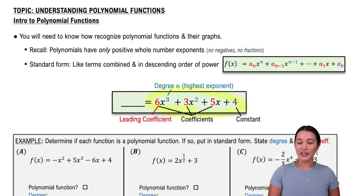
Quadratic Functions
Quadratic functions are polynomial functions of degree two, typically expressed in the form f(t) = at² + bt + c. In this context, both height functions f(t) and g(t) are quadratic, representing the motion of the stones under the influence of gravity. Understanding the properties of these functions, such as their vertex and maximum height, is crucial for determining when both stones reach the same height.
Recommended video:
Introduction to Polynomial Functions
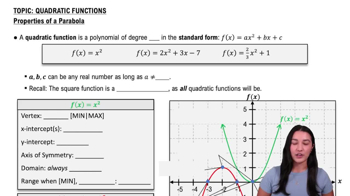
Vertex of a Parabola
The vertex of a parabola is the highest or lowest point of the graph, depending on its orientation. For the given height functions, the vertex represents the maximum height reached by each stone. The vertex can be found using the formula t = -b/(2a), where a and b are coefficients from the quadratic equation, allowing us to calculate the time at which each stone reaches its peak height.
Recommended video:
Properties of Parabolas
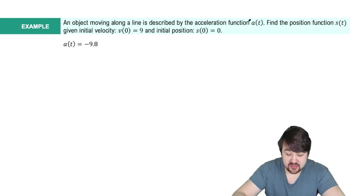
Initial Velocity and Its Impact
Initial velocity is the speed at which an object is thrown or projected at the start of its motion. In this problem, the initial velocity v0 of the second stone affects its height function g(t) and ultimately determines the time and height at which it reaches its maximum. By equating the maximum heights of both stones, we can solve for v0, ensuring both stones reach the same high point.
Recommended video:
Initial Value Problems Example 2
Related Practice
Textbook Question
1
views
Textbook Question
A line perpendicular to another line or to a tangent line is often called a normal line. Find an equation of the line perpendicular to the line that is tangent to the following curves at the given point P.
y= √x; P(4, 2)
Textbook Question
Derivatives Find the derivative of the following functions. See Example 2 of Section 3.2 for the derivative of √x.
f(s) = √s/4
2
views
Textbook Question
Water is drained out of an inverted cone that has the same dimensions as the cone depicted in Exercise 36. If the water level drops at 1 ft/min, at what rate is water (in ft³/min) draining from the tank when the water depth is 6 ft?
Textbook Question
Explain why b^x = e^xlnb.
Textbook Question
5–8. Calculate dy/dx using implicit differentiation.
e^y-e^x = C, where C is constant