Ch. 3 - Derivatives
Briggs - Calculus: Early Transcendentals 3rd Edition
Briggs3rd EditionCalculus: Early TranscendentalsISBN: 9780136847243Not the one you use?Change textbook
Chapter 3, Problem 85d

Finding derivatives from a table Find the values of the following derivatives using the table. <IMAGE>


d. d/dx (f(x)³) |x=5

Verified step by step guidance
1
Step 1: Recognize that you need to find the derivative of a composite function, specifically \( f(x)^3 \). This requires the use of the chain rule.
Step 2: Apply the chain rule. The chain rule states that the derivative of \( g(f(x)) \) is \( g'(f(x)) \cdot f'(x) \). Here, \( g(x) = x^3 \) and \( f(x) \) is the inner function.
Step 3: Differentiate \( g(x) = x^3 \) to get \( g'(x) = 3x^2 \). Therefore, \( g'(f(x)) = 3(f(x))^2 \).
Step 4: Multiply \( g'(f(x)) \) by \( f'(x) \) to get the derivative: \( \frac{d}{dx}(f(x)^3) = 3(f(x))^2 \cdot f'(x) \).
Step 5: Evaluate this expression at \( x = 5 \) using the values from the table for \( f(5) \) and \( f'(5) \). Substitute these values into the expression to find the derivative at \( x = 5 \).

Verified video answer for a similar problem:

This video solution was recommended by our tutors as helpful for the problem above.
Video duration:
3m
Was this helpful?

Key Concepts

Here are the essential concepts you must grasp in order to answer the question correctly.

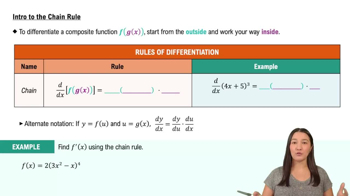
Chain Rule

The Chain Rule is a fundamental principle in calculus used to differentiate composite functions. It states that if you have a function that is composed of two or more functions, the derivative of the outer function is multiplied by the derivative of the inner function. For example, if y = f(g(x)), then dy/dx = f'(g(x)) * g'(x). This rule is essential for finding the derivative of f(x)³ in the given question.
Recommended video:
05:02
Intro to the Chain Rule

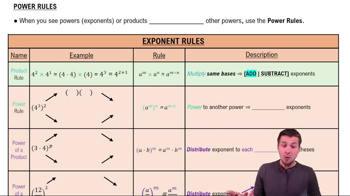
Power Rule

The Power Rule is a basic differentiation rule that states if f(x) = x^n, where n is a real number, then the derivative f'(x) = n*x^(n-1). This rule simplifies the process of finding derivatives of polynomial functions. In the context of the question, applying the Power Rule to f(x)³ will help in calculating the derivative needed at x=5.
Recommended video:

Evaluating Derivatives at a Point

Evaluating derivatives at a specific point involves substituting the value of x into the derivative function after it has been calculated. This process provides the slope of the tangent line to the function at that particular point. In this case, after finding the derivative of f(x)³ using the Chain and Power Rules, you will substitute x=5 to find the required derivative value.
Recommended video:
04:50
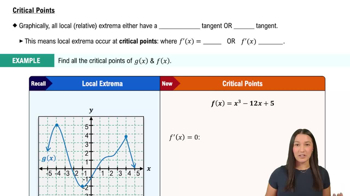
Critical Points