Ch. 3 - Derivatives
Briggs - Calculus: Early Transcendentals 3rd Edition
Briggs3rd EditionCalculus: Early TranscendentalsISBN: 9780136847243Not the one you use?Change textbook
Chapter 3, Problem 3.8.10

Find the slope of the curve x²+y³=2 at each point where y=1 (see figure). <IMAGE>

Verified step by step guidance
1
First, understand that the problem requires finding the slope of the curve at points where y = 1. The slope of a curve at a point is given by the derivative of the curve with respect to x, which is dy/dx.
To find dy/dx, we need to differentiate the given equation implicitly. The equation is x² + y³ = 2. Differentiate both sides with respect to x. Remember that y is a function of x, so when differentiating y³, use the chain rule.
Differentiating x² with respect to x gives 2x. Differentiating y³ with respect to x gives 3y²(dy/dx) using the chain rule. The derivative of the constant 2 is 0.
Set up the equation from the differentiation: 2x + 3y²(dy/dx) = 0. Solve for dy/dx to find the slope of the curve. Rearrange the equation to isolate dy/dx: dy/dx = -2x / 3y².
Substitute y = 1 into the equation dy/dx = -2x / 3y² to find the slope at points where y = 1. This simplifies to dy/dx = -2x / 3. The slope at these points depends on the value of x, which can be found by substituting y = 1 back into the original equation to solve for x.

Verified video answer for a similar problem:

This video solution was recommended by our tutors as helpful for the problem above.
Video duration:
3m
Was this helpful?

Key Concepts

Here are the essential concepts you must grasp in order to answer the question correctly.

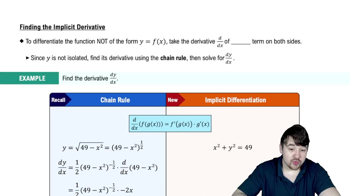
Implicit Differentiation

Implicit differentiation is a technique used to find the derivative of a function defined implicitly by an equation involving both x and y. Instead of solving for y explicitly, we differentiate both sides of the equation with respect to x, treating y as a function of x. This allows us to find dy/dx, which represents the slope of the curve at any given point.
Recommended video:
05:14
Finding The Implicit Derivative

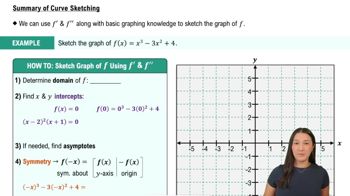
Slope of a Curve

The slope of a curve at a given point is defined as the rate of change of the y-coordinate with respect to the x-coordinate at that point. Mathematically, it is represented by the derivative dy/dx. For a curve defined by an equation, the slope can be evaluated by substituting the coordinates of the point into the derivative obtained through implicit differentiation.
Recommended video:
11:41
Summary of Curve Sketching

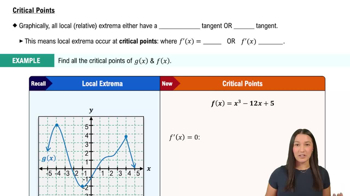
Evaluating Derivatives at Specific Points

Once the derivative of the curve is found, evaluating it at specific points involves substituting the x and y values of those points into the derivative expression. In this case, since we are interested in points where y=1, we will first find the corresponding x values from the original equation and then substitute these into the derivative to find the slope at those points.
Recommended video:
04:50
Critical Points